
Araraquara and Dourados – the cities with the fastest fixed broadband internet in Brazil (227 Mbps)
Publication date: 23/08/2026
An analysis of 125 Brazilian cities in terms of download speeds shows a country literally divided into two speeds. The average fixed internet download speed for all analyzed cities is very good at 153 Mbps, but the differences between cities are massive: from 227 Mbps in Araraquara, São Paulo, to just 43 Mbps in Caruaru, Pernambuco. That is a more than fivefold difference between two cities with a similar population.
We analyzed fixed internet speeds in 125 Brazilian cities based on speed test results conducted between July 2025 and June 2026 on V-SPEED mobile applications (including SpeedGeo). The average fixed internet speed for the whole of Brazil during this period was 138 Mbps for download, 106 Mbps for upload, and 29 ms for latency.
Fastest fixed internet in the cities of São Paulo state
The top of the rankings is dominated by mid-sized cities from the state of São Paulo - Araraquara (227 Mbps), Santos (221 Mbps), Sorocaba (208 Mbps), São Caetano do Sul (207 Mbps), Ribeirão Preto (204 Mbps), and Jundiaí (197 Mbps). None of them are metropolises, yet they outpace the state capital and the country's economic hub, São Paulo (184 Mbps). Competition in these cities is fierce - the "Big Three" (Vivo, Claro, TIM) operate here alongside dozens of local fiber ISPs, which have been the driving force behind network expansion in Brazil for years. A major role is also played by the proximity to traffic exchange points and the backbone network of São Paulo state, which remains the country's main internet hub.
The result for the city of São Paulo itself points to the effect of legacy investments - alongside dominant FTTH, older cable and DSL installations are still in operation, pulling down the average.
The top tier also includes Dourados (227 Mbps, Mato Grosso do Sul), Aparecida de Goiânia (212 Mbps, Goiás), Maringá (210 Mbps, Paraná), and Vila Velha (199 Mbps, Espírito Santo).
Top 10 Cities with the Fastest Internet in Brazil
| No. | City | Download Speed [Mb/s] | Upload Speed [Mb/s] |
| 1 |
227 |
162 |
|
| 2 |
227 |
158 |
|
| 3 |
221 |
106 |
|
| 4 |
212 |
174 |
|
| 5 |
210 |
162 |
|
| 6 |
208 |
129 |
|
| 7 |
207 |
103 |
|
| 8 |
204 |
138 |
|
| 9 |
199 |
170 |
|
| 10 |
199 |
106 |
In 35 out of 125 cities, Vivo provided the fastest internet, while Claro dominated in 25 cities and Nio in 14. In approximately 40% of the cities, speed leaders were regional and local providers; for example, Desktop came out on top in 3 cities, Brisanet, Algar, and Giga+ led in two cities each, and each of the remaining internet service providers took the lead in a single city.
Large metropolises in the middle of the list
Rio de Janeiro (153 Mbps), Porto Alegre (183 Mbps), Belo Horizonte (182 Mbps), and São Paulo (184 Mbps) rank more toward the middle of the list. This picture is typical of mature telecommunications markets: infrastructure is everywhere, but its age and deployment conditions (historic street layouts, dense office districts, favelas requiring custom wiring) prevent the average from reaching the levels seen in younger, "built-from-scratch" networks in smaller cities.
The slowest internet is in the Nordeste
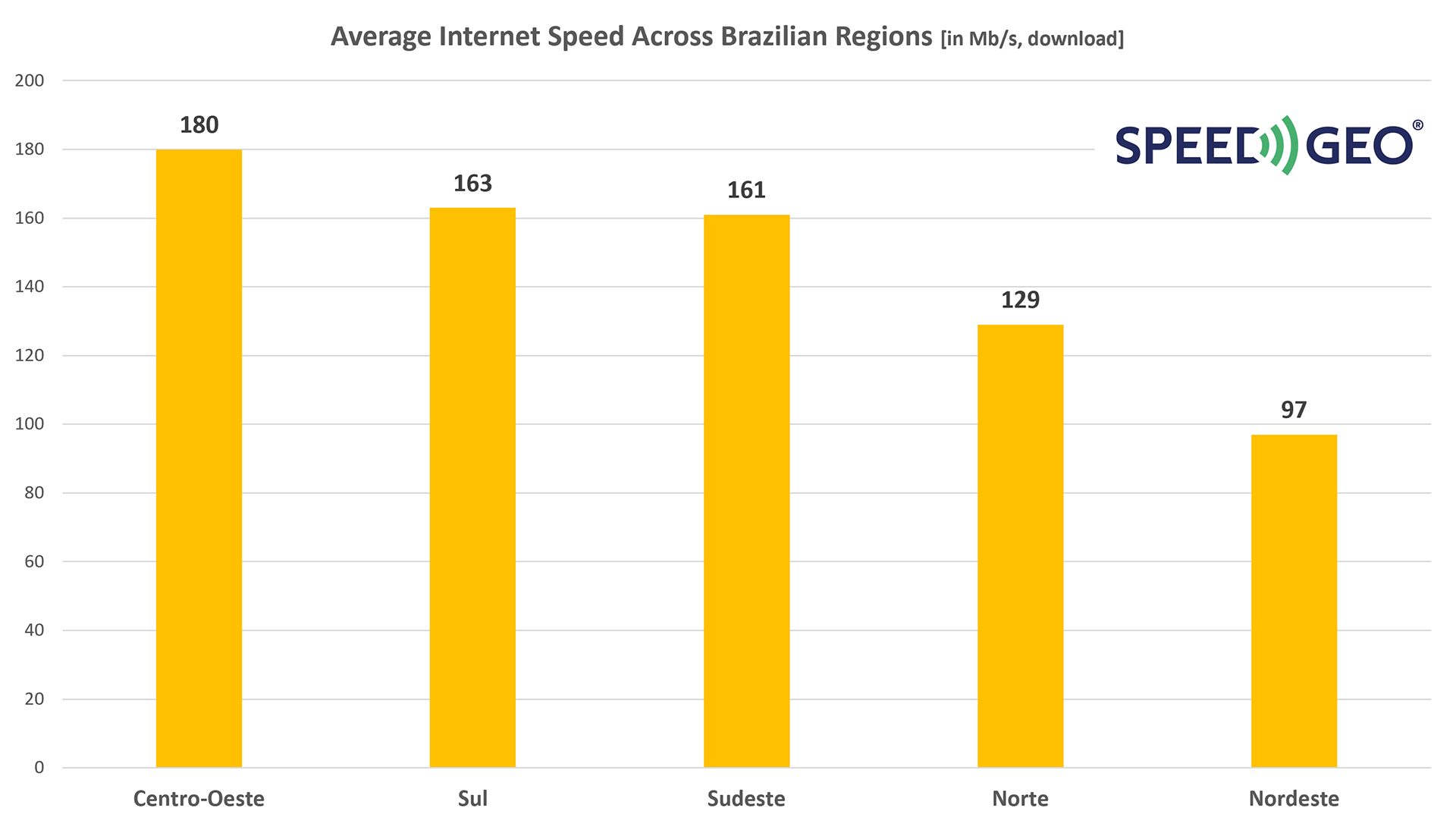
Regional differences are also significant. Despite including metropolises such as Recife, Salvador, Fortaleza, and João Pessoa, the Nordeste region records the lowest average download speed in the country—nearly half that of the Centro-Oeste region. At the very bottom of the city ranking lie centers from Pernambuco, Paraíba, and Alagoas: Caruaru, Campina Grande, Imperatriz, Arapiraca, Jaboatão dos Guararapes, Paulista, Camaçari, and—particularly telling—Recife itself (85 Mbps), the regional economic capital. Of course, the average speed for cities in the region is still quite good, but it nevertheless highlights a lag compared to leading regions.
5 cities with the slowest internet in Brazil:
| No. | City | Download Speed [Mb/s] | Upload Speed [Mb/s] |
| 1 |
71 |
60 |
|
| 2 |
66 |
63 |
|
| 3 |
62 |
76 |
|
| 4 |
45 |
46 |
|
| 5 |
43 |
41 |
The analysis reveals two pattern trends:
-
City size barely correlates with speed. The quality of internet in a Brazilian city is not determined by its population or economic output, but rather by how many providers actively compete with one another and how recently the infrastructure was built. Cities that expanded their internet networks relatively late invested directly in fiber optics—skipping the DSL and cable phase altogether. This accounts for their high results and explains why mid-sized cities with a few hundred thousand residents in São Paulo state outpace major metropolises like Rio de Janeiro or São Paulo city.
-
Fiber optics dominate Brazil's urban environment. Cities with high download speeds also exhibit high upload speeds—a classic hallmark of fiber-optic networks (FTTH/GPON), which offer relatively symmetrical bandwidth. All analyzed cities show an upload-to-download ratio greater than 50% (typically 70–90%), confirming that fiber optics serve as the primary access technology.