
Broadband in Indonesia: MyRepublic Leads with Speeds of 81 Mbps
Publication date: 26/11/2026
MyRepublic has climbed from third place in 2023 to become Indonesia’s fastest fixed broadband provider in 2026. The operator’s average download speed quadrupled from 20 Mbps in 2023 to 81 Mbps in 2026, compared to the current national average of 44 Mbps.
According to January’s SpeedGeo report, Indonesia ranked 32nd out of 43 analyzed countries in Asia. In 2025, the country’s average download speed was 29 Mbps, and in 2026 (through September) it jumped by 52% to 44 Mbps. The pace of change indicates that the Indonesian market is undergoing a rapid transformation-and there is plenty of room for growth, as only one in five households currently has a fixed broadband connection.
Why Is MyRepublic Winning?
We analyzed data from nearly 1 million tests conducted on Indonesian fixed-line networks by users of the SpeedGeo measurement platform. MyRepublic emerged as the speed leader in 2026. Over three years, the operator’s average download speed nearly quadrupled. In 2026 alone, it doubled to 81 Mbps, allowing MyRepublic to overtake Biznet, which had held the lead from 2023 to 2025.
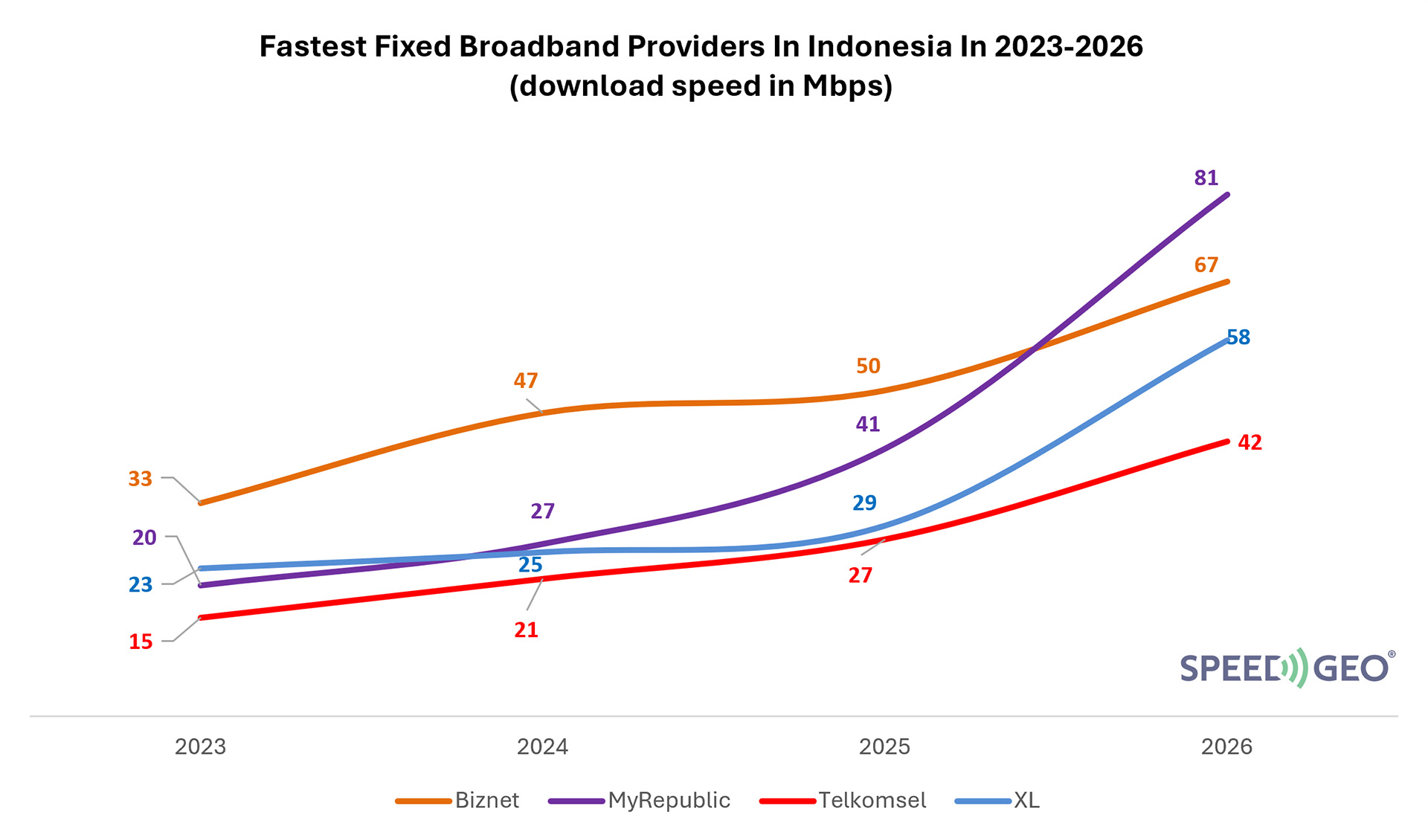
2026 was a breakthrough year for almost the entire market. XL also doubled its speed, while Telkomsel improved its result by 55%. Only Biznet, which started from the highest baseline, grew at a slower pace. When it comes to speed, the market is dominated by three alternative operators ahead of Telkomsel.
MyRepublic’s advantage stems from several factors. The first is its reliance primarily on fiber optics (although in 2026 it began actively selling FWA on the 1.4 GHz band, which will likely accelerate subscriber growth but could lower average speeds). The second factor is its product and customer base. MyRepublic targets urban households, younger users, and gamers-a demographic that typically opts for higher-tier plans than the national average. The third is its merger with Moratelindo, which provided its own backbone network and a base of enterprise clients. The fourth factor is the relatively low price for a 100 Mbps plan, as affordability remains one of the main pain points for Indonesian consumers. Notably, over the past three years, the share of speed tests from MyRepublic users has tripled, indirectly pointing to significant market share growth.
What’s Next for Broadband in Indonesia: Technology and Regulation
Fiber to the home (FTTH) is now the standard in Indonesian cities, though operators are entering this space with very different legacies. Telkomsel inherited a network built over decades, and part of its subscriber base also relies on FWA access. This is clearly reflected in its upload-to-download speed ratio of 57%, the lowest among the four fastest operators. MyRepublic and Biznet, by contrast, built their networks from the ground up using GPON technology, making their connections nearly symmetrical (with upload-to-download ratios of 93% and 94%, respectively). In 2024–2025, MyRepublic’s upload speeds even exceeded its download speeds-a noticeable advantage for gamers, content creators, and remote workers.
Fixed Wireless Access (FWA) on the 1.4 GHz band is emerging as the second technological pillar. The government allocated this spectrum exclusively for home internet to reach areas where digging trenches for fiber to every household is not economically viable. The strategic plan of the Ministry of Communication and Digital Affairs, Komdigi (Renstra 2025-2029), targets average speeds of 45-64 Mbps in 2026 and 100 Mbps by 2029. By the end of the decade, fiber is expected to reach 90% of subdistricts, with half of all households subscribing to fixed broadband.
However, the biggest barrier is not speed, but price. The primary tool for improving affordability became the 1.4 GHz spectrum auction concluded in October 2025, which imposed specific pricing obligations on the winners.
Another major obstacle to fixed infrastructure rollout is high leasing/right-of-way fees and inconsistent regulations set by local governments. In October 2026, Komdigi announced a comprehensive review of telecommunications regulations in consultation with the industry. Its core focus will be infrastructure sharing, alongside standards covering not only speed, but also service quality-welcome news for alternative operators.