Deutsche Glasfaser: The Master of German Internet Speed (January 2026)
Publication date: 26/02/2026
In 2026, the German broadband market is undergoing the most significant technological transformation in its history. There is a massive shift away from copper-based DSL connections toward fiber optics (FTTH/B), while HFC technology maintains a strong presence in major cities. In the shadow of investments by industry giants, Deutsche Glasfaser-Germany's fastest broadband provider-is consistently executing its strategy.
Deutsche Glasfaser – Unrivaled in Germany in January 2026
We have analyzed broadband speeds in Germany for January 2026 alone. Based on over 314,000 tests conducted by users of V-SPEED (the owner of the SpeedGeo app) on broadband networks, a clear picture of the German market is emerging.. The fastest home internet provider is Deutsche Glasfaser (193.5 Mbps), ahead of Vodafone (172.6 Mbps) and with a significant lead over Telekom (92.3 Mbps). The operator boasts an unrivaled upload speed (132 Mbps), which is 3–4 times faster than its competitors. Crucially for gamers, the network latency is just 16 ms - the best (lowest) result on the market.
|
Internet Service Provider |
Download [Mbps] |
Upload [Mbps] |
Latency [ms] |
| Deutsche Glasfaser | 193,5 | 132,3 | 16 |
| Vodafone | 172,6 | 31,8 | 27 |
| Telekom | 92,3 | 38,3 | 25 |
Fiber Optic Specialists
Deutsche Glasfaser is a mid-sized operator-by the standards of the German telecommunications industry-with approximately a 4% market share. It consistently implements a market strategy distinct from that of the major players:
-
Full focus on fiber optics: Unlike the market giants who spent years modernizing legacy solutions (VDSL/Vectoring or HFC/DOCSIS), Deutsche Glasfaser is a "pure-play" operator. The company focuses exclusively on building modern networks based on pure fiber optics.
-
Investments in suburban and rural areas: Unlike the largest operators, Deutsche Glasfaser does not fight for Berlin or Munich. Instead, it dominates in small municipalities where it is often the sole provider of high-speed internet. Thanks to this company, many small towns in Germany skipped the "slow internet" phase entirely, gaining immediate access to 1 Gbps connections. While infrastructure in large city centers is often outdated and difficult to replace (due to the high cost of street excavation), Deutsche Glasfaser efficiently deploys fiber in smaller municipalities where the process is faster and more cost-effective. It is worth noting the German paradox: the highest quality of internet service is often found in rural and suburban areas, while connection parameters in major metropolitan areas can be paradoxically lower.
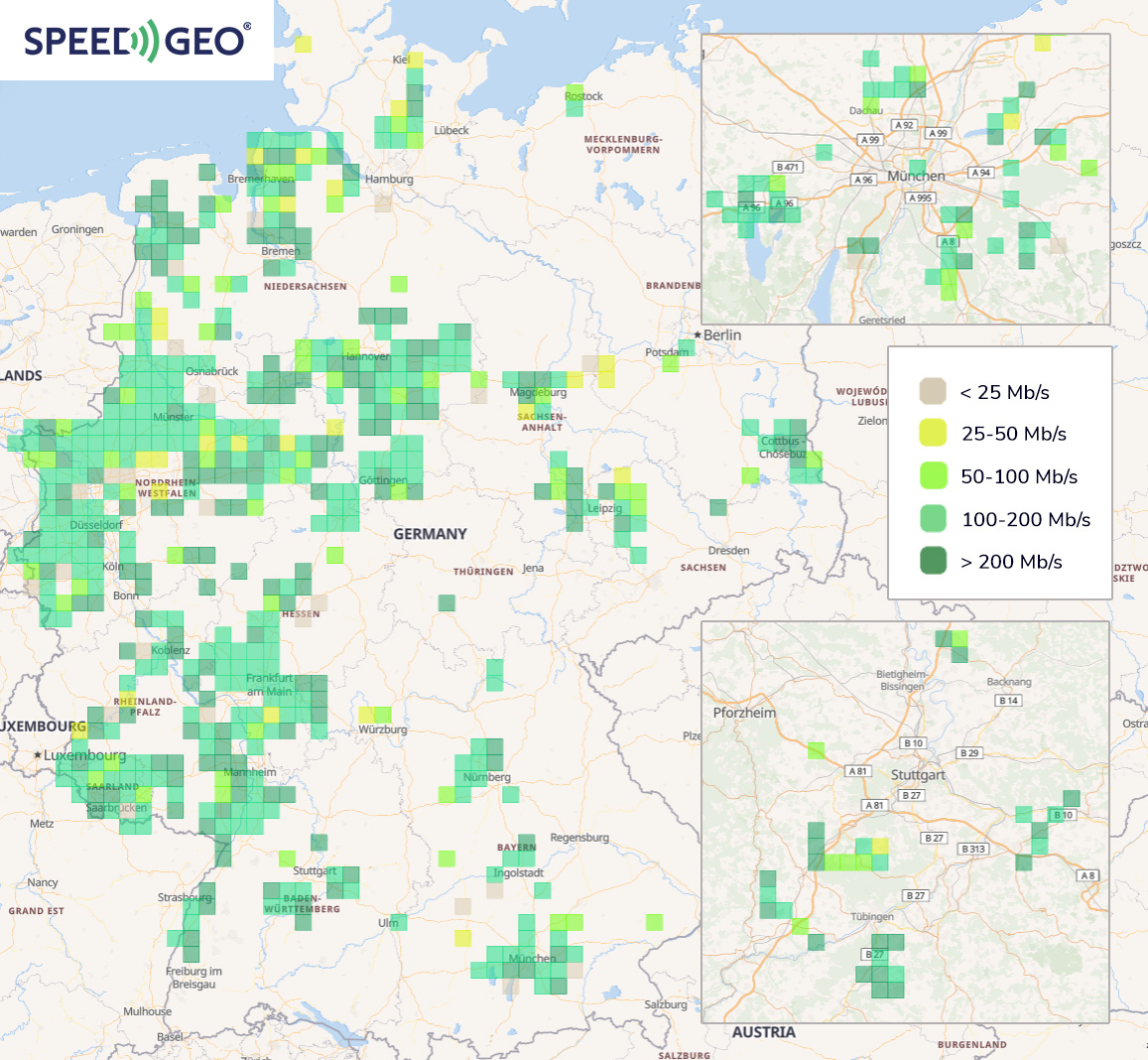
Below, we present the distribution of SpeedGeo user tests within the Deutsche Glasfaser network, alongside an example of their network development strategy around major cities (Munich and Stuttgart areas).