
The popularity and speed of Starlink are increasing in Poland
Publication date: 08/09/2025
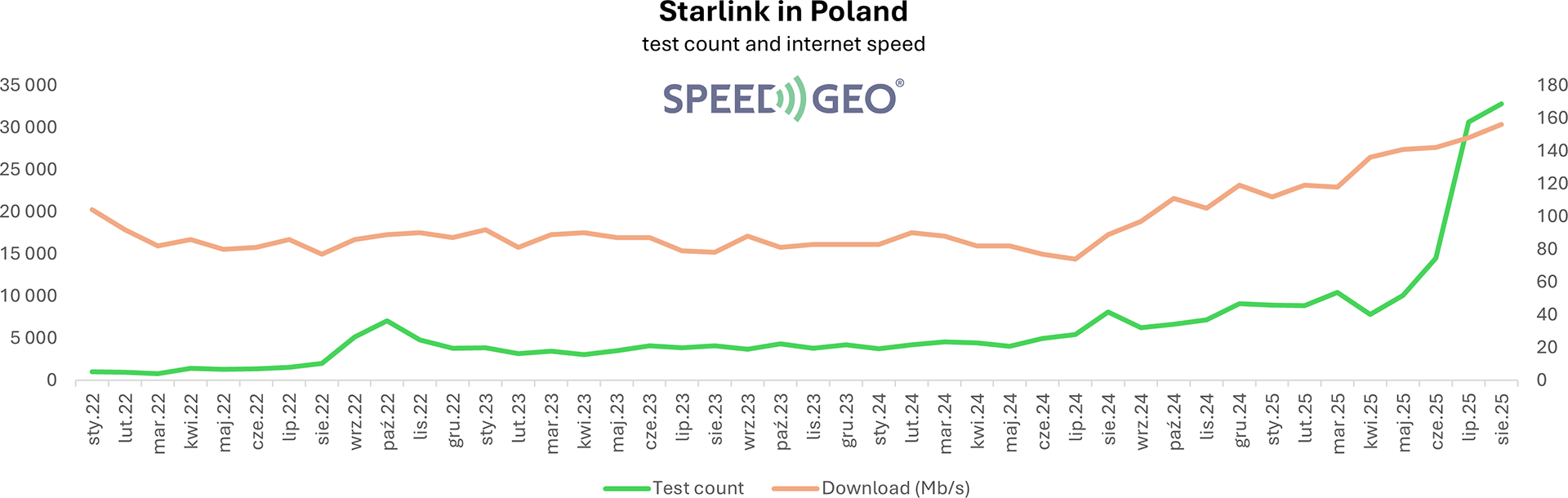
For four years after its launch in Poland, Starlink’s internet service remained a niche product due to its high costs. This changed in June 2025, after a price drop and a new offer. Interest in the service grew, and for the first time the provider qualified for SpeedTest.pl’s home ranking. Speeds also improved, reaching a solid 156 Mbps.
Starlink launched in Poland in September 2021. Initially, the antenna kit cost over PLN 2,200, while the monthly subscription was PLN 449. The product attracted significant media attention, but the high price was a major barrier, which is why speed tests for this operator rarely appeared on the SpeedTest.pl platform. In the following years, the offer was adjusted, but it still remained financially out of reach for the average Pole. At the time, internet speeds ranged from 80-100 Mbps, sufficient for the average household’s needs.
Starlink lowers prices in mid-2025
A major change in the offer came in mid-2025, when the home subscription was reduced to PLN 149 or PLN 215 depending on the option, with equipment priced at PLN 1,499. The company also introduced the possibility of using the equipment free of charge with a 12-month commitment and a PLN 215 monthly fee.
The cheaper offer and the introduction of a loyalty contract sparked a significant surge in interest. The number of speed tests grew several times over, reaching a record 33,000 in August - nearly 1% of all home internet speed tests conducted that month on SpeedTest.pl in Poland. In June, the provider qualified for SpeedTest.pl’s home internet ranking for the first time.
Starlink doubles its speed
Over the past 14 months, download speeds have doubled - from 74 Mbps in July 2024 to 156 Mbps in August 2025. During the same period, ping was nearly halved, dropping from 60 ms to 32 ms. Upload speeds now reach almost 25 Mbps. The improvement in service parameters is most likely connected to the operator’s recent addition of a significant number of satellites to the constellation and the expansion of its network backbone.
Internet “for the summer house” and “for guesthouses”
The map of test distribution clearly reflects the expected use cases of this product. As intended, it is used in areas without cable connections and with weak mobile internet coverage. Most tests were recorded near the largest cities, which strongly suggests that it is internet “for the countryside home,” “for the summer cottage,” “for guesthouses,” and “for camping.”
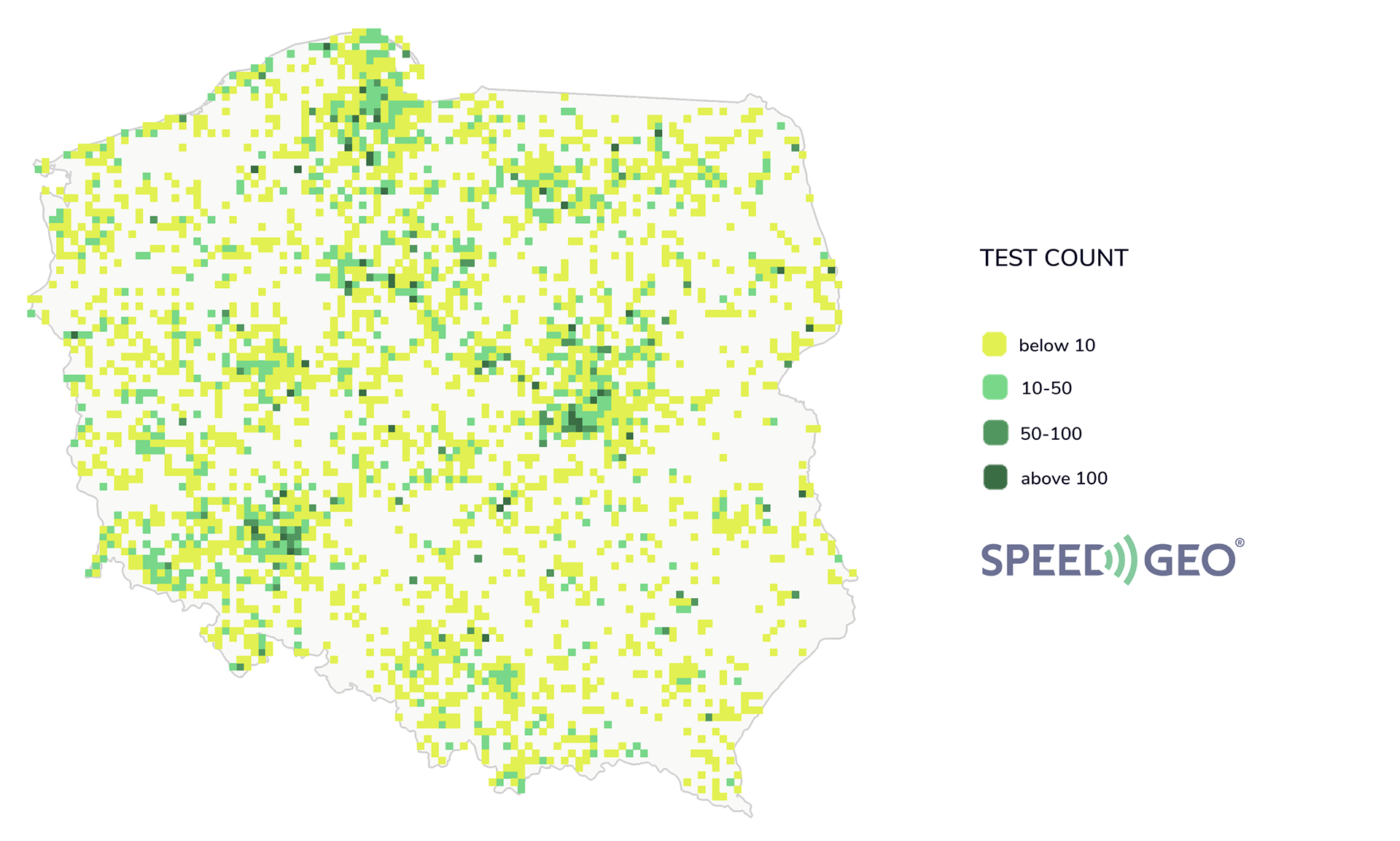
The highest concentration of tests can be observed:
-
around Warsaw, especially to the southwest toward Skierniewice, Rawa Mazowiecka, and Grójec, as well as near the Zegrze Reservoir,
-
around Wrocław (mainly west of the city),
-
around Bydgoszcz and Toruń,
-
near the Tri-City and throughout the broader Kashubia region, a traditional leisure destination for residents of the metropolitan area,
-
in Warmia and Masuria, mainly in the large forest complexes between Iława and Szczytno,
-
along the Baltic Coast, where users are likely caravan owners,
-
and in the Sudetes.
The further development of this provider’s services in Poland will be interesting to watch. Until recently, Starlink was a rather exclusive service due to its high price. After the recent changes, it is becoming a realistically accessible product for a wider audience, although prices are still considerably higher than those of mobile competitors. The product’s future popularity will undoubtedly be determined by price. Polish mobile operators are also competing for customers in areas where service quality is still insufficient, now expanding their networks with access to the 700 MHz band. For many users, the dilemma of price versus quality will remain relevant - but from a customer perspective, having as wide a choice as possible is certainly a positive.
This article was prepared in cooperation with SpeedTest.pl.