War-Torn Ukraine Boosts Internet Speeds by Over 140%
Publication date: 25/06/2026
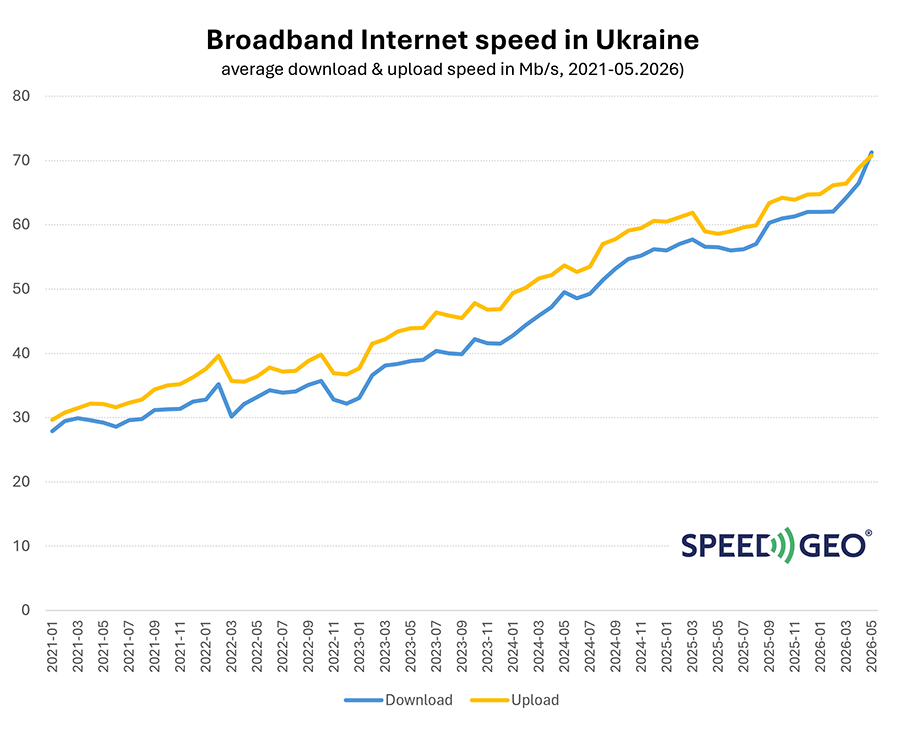
Despite the ongoing war that began in February 2022, Ukraine's internet has not only survived but has significantly accelerated. According to data from SpeedGeo, the average mobile download speed increased from 17.3 Mbps (January 2021) to 42.4 Mbps (May 2026), while fixed broadband speed rose from 27.9 to 71.3 Mbps - an increase of approximately 145% and 156%, respectively. However, the upward trend line shows recurring, sharp drops that coincide with key moments of the war: the outbreak of the invasion and subsequent winter campaigns of Russian attacks on the energy infrastructure.
The report was prepared based on 6.3 million tests conducted via the www.speedgeo.net internet speed measurement applications and the SpeedGeo App.
The Impact of Infrastructure Destruction on Internet Speeds in Ukraine
As recently as 2021, Ukraine's internet speeds were growing steadily. The first and most severe drop in network quality occurred at the beginning of the Russian invasion in late February and early March 2022 (light green on the chart), when several hundred base stations were knocked offline due to damage or power outages in combat zones. During this period, the average mobile speed plummeted from 20.6 to 14.1 Mbps (−31.6% in a single month), while fixed broadband dropped from 35.2 to 30.2 Mbps (−14.2%). This highlights a clear asymmetry: the mobile network was hit more than twice as hard.
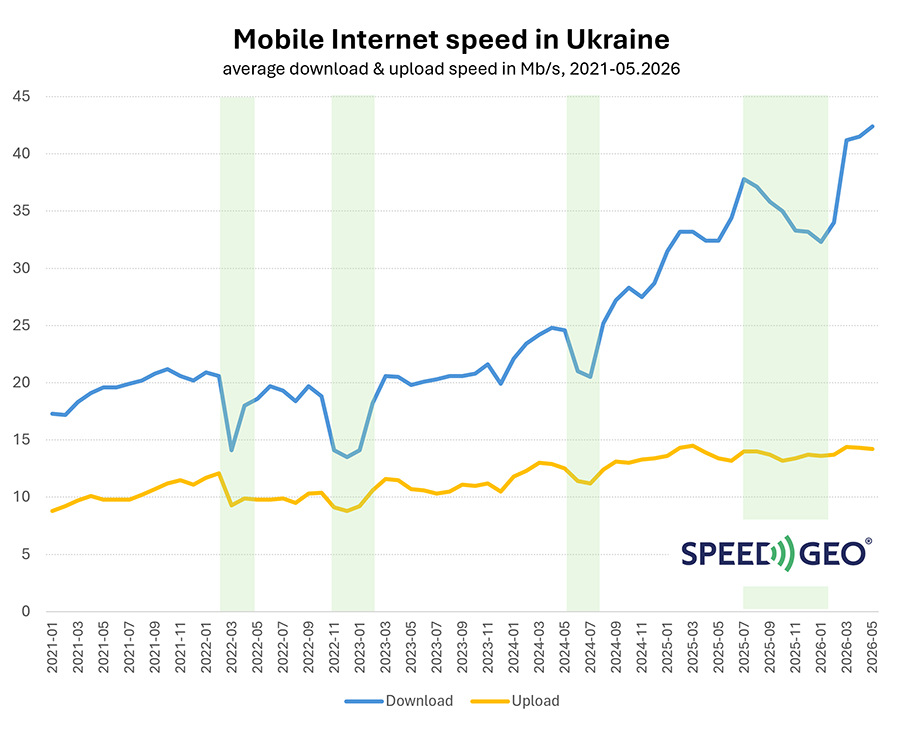
The main cause of the drops was not direct strikes on towers, but attacks on the power grid. Starting in autumn 2022, Russia launched cyclical, typically autumn-winter missile and drone campaigns targeting power plants and transmission networks. This impact is visible in the data as seasonal "dips":
-
Winter 2022/23: the average mobile speed fell from 18.8 (Oct) to 13.5 Mbps (Dec) - by about 28% — while fixed broadband decreased by only about 10%.
-
Mid-2024: following a spring wave of strikes, the average speed slipped from 24.6 (May) to 20.5 Mbps (Jul).
-
Autumn 2025 and winter 2025/2026: further declines against the backdrop of an ongoing upward trend.
During a power outage, a fixed line equipped with its own UPS or an xPON fiber connection can keep running for hours. Meanwhile, traffic from some users simply disappears (no router power = no test performed, which doesn't lower the recorded speed). The mobile network degrades differently: when power-deprived base stations shut down, users log onto neighboring, overloaded towers, which heavily reduces bandwidth across the remaining cells.
The mobile network responded to these shocks much more severely than the fixed network - it was far more vulnerable to power outages. Unsurprisingly, during peak blackouts, the number of speed tests conducted by our users on mobile networks more than doubled. It is the picture of a society checking if they still have a signal.
Yet, despite destruction estimated at around 25% of Ukraine's telecommunications infrastructure, a steady upward trend in network quality dominates. This is driven by modernization, frequency auctions, and foreign investments, all paradoxically carried out in the midst of the war.
What helped Ukraine maintain network business continuity?
Right at the beginning of the invasion, the three largest operators (Kyivstar, Vodafone, lifecell) launched national roaming, allowing phones to automatically log onto another network after losing their own signal. Telecommunications was classified as critical infrastructure on par with the energy sector, which ensured, among other things, priority fuel deliveries for generators. Operators equipped base stations with batteries and generators on a massive scale. The most ingenious solution was using electric vehicles as mobile power supplies - a car would drive up to a blacked-out tower and power it like a giant power bank on wheels. It is impossible not to mention the work of power grid specialists, who worked miracles repairing ongoing damage to power plants and transmission networks. The state also launched thousands of "Points of Invincibility" - public hubs offering electricity, heat, device charging, and free Wi-Fi (often via Starlink). In 2023, auctions for the 2100/2300/2600 MHz bands were held, which triggered the surge in speeds seen in 2025–2026. The time required to issue permits for building network towers was also significantly shortened. Starlink plays a critical role for the military, though from the perspective of an "ordinary" internet user, it is of much less significance as it could not replace the mass-market network. Additionally, 5G testing has begun in cities like Lviv and Kyiv.
Ukraine Boasts Faster Mobile Internet Than Russia and Belarus
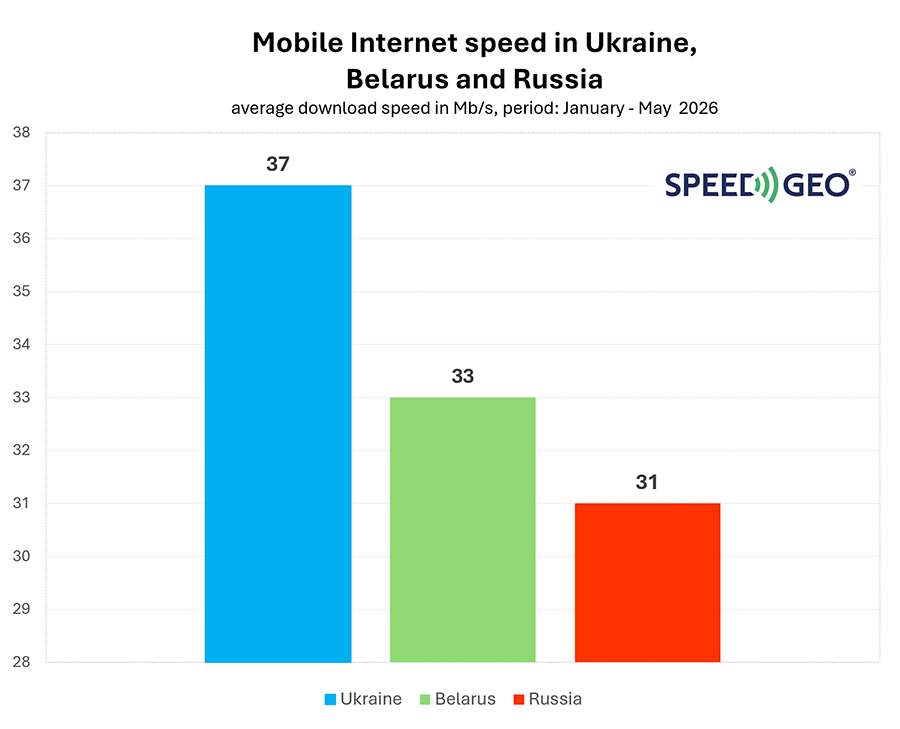
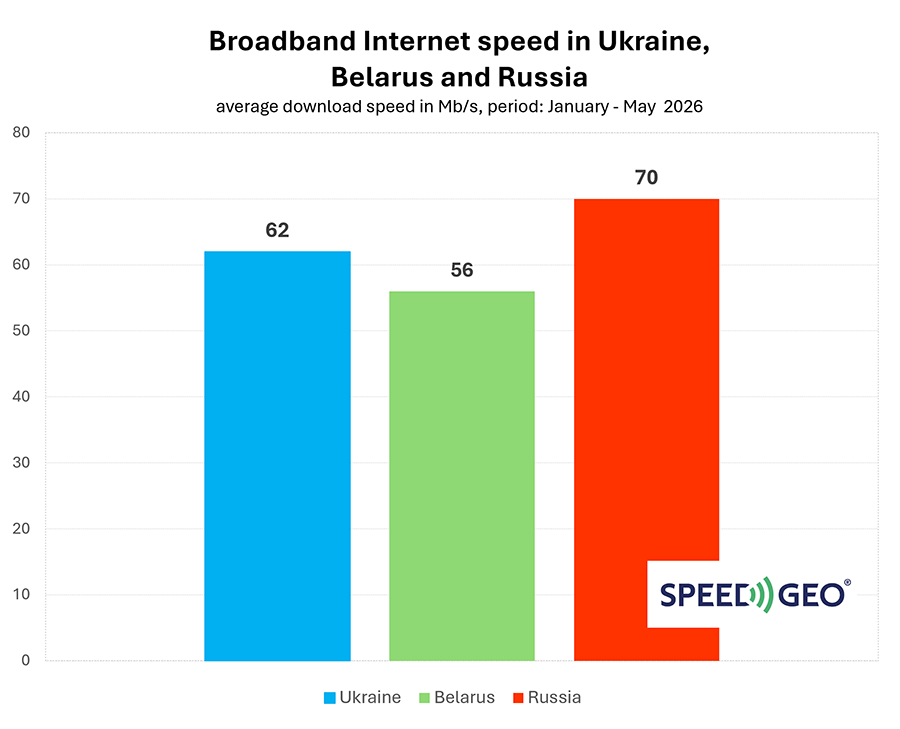
The effort of Ukrainians to maintain network business continuity is best illustrated by comparing internet speeds from January to May 2026 across Ukraine, Belarus, and Russia - nations established after the collapse of the USSR. One might think that a country in its fifth year of war would lag far behind its neighbors, but nothing could be further from the truth: Ukraine is not falling behind, and in some aspects, it is actually leading the pack. Currently, Ukrainians enjoy the fastest mobile internet among the three (37 Mbps) and trail Russia only slightly when it comes to fixed broadband speeds. It is an extraordinary situation that a nation under fire is managing so exceptionally well in maintaining a fully operational internet access infrastructure.