
Philippines: Internet speed jumps 8x between 2020 and 2026
Publication date: 27/10/2026
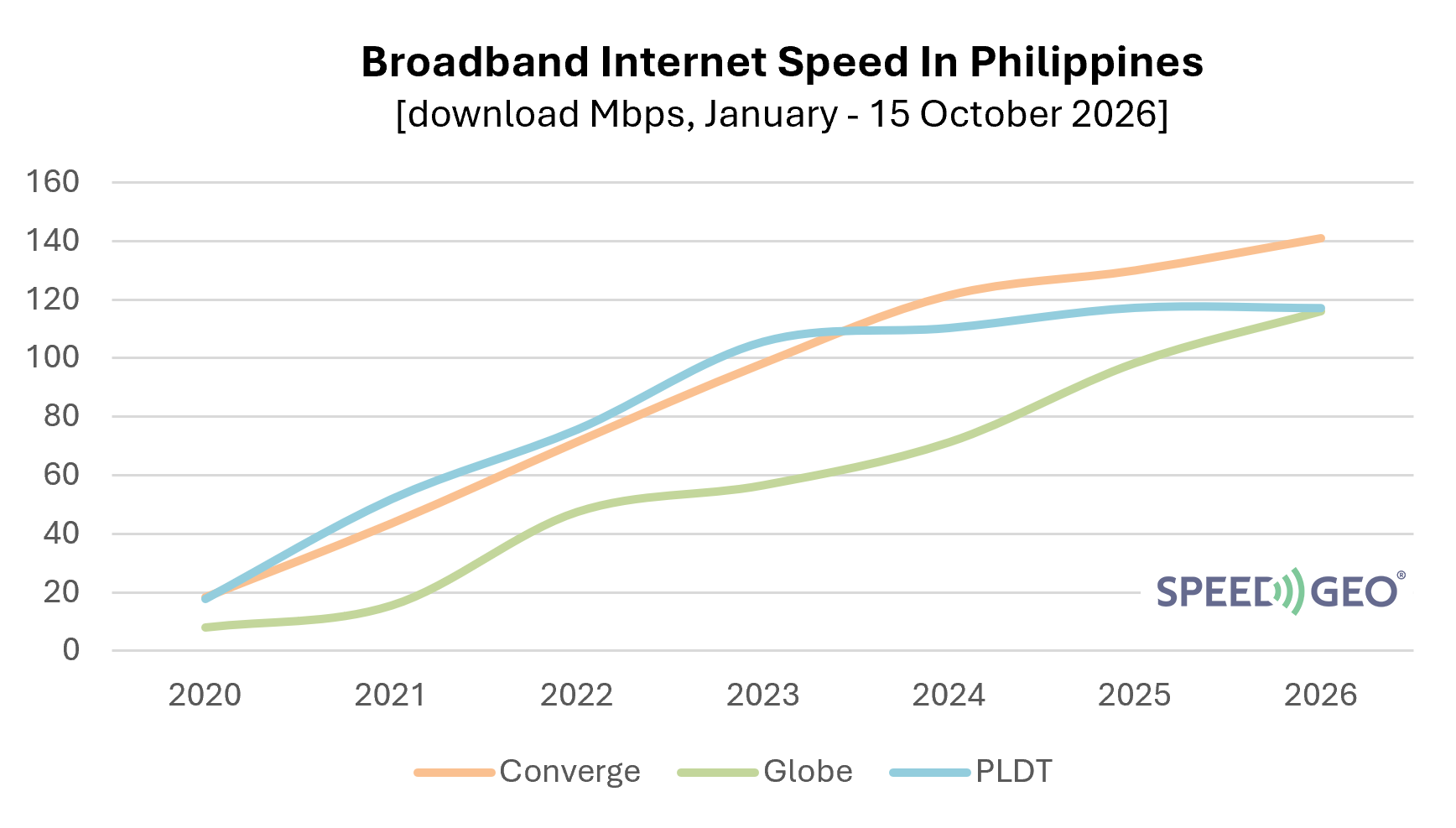
The Philippines has undergone a massive transformation in fixed broadband quality-over the past 6 years, the average speed has increased 8-fold, from 14 to 109 Mbps. The main drivers of this growth were the fiber rollout and fierce competition among the top three operators: Converge, PLDT, and Globe. In 2020, the average download speed for these providers ranged from 8 to 18 Mbps, whereas in 2026, it reached between 116 and 141 Mbps. The analysis was conducted based on 5.3 million user tests from the V-SPEED applications (including SpeedGeo).
Converge: The fastest Internet provider in the Philippines since 2024
Speeds grew most rapidly between 2020 and 2023, when operators were expanding their FTTH fiber-optic coverage. Converge, which built a pure fiber network right from the start, became the speed leader according to SpeedGeo users in 2024, reaching an average download speed of 141 Mbps as the market leader in 2026. PLDT started from a similar level as Converge, but its speed growth slowed down significantly after 2023 (105.5 → 117 Mbps). Globe started from the lowest point (8 Mbps in 2020) but caught up with PLDT in 2026 (116 Mbps).
Upload speeds on fiber networks have nearly equaled download speeds, which is typical for GPON technology. Operators' rankings in Internet speed primarily depend on the proportion of fiber optics in their infrastructure-which is why Converge leads the market, as it likely holds the highest share of FTTH technology. However, Internet speed is also significantly influenced by Wi-Fi quality and plan speed caps.
Table. Speed parameters of 3 main home Internet operators in the Philippines (January – October 15, 2026)
|
Internet Service Provider |
Download [Mbps] |
Upload [Mbps] |
Latency [ms] |
|
Converge |
140,7 |
126,9 |
28 |
|
PLDT |
117,1 |
108,9 |
26 |
|
Globe |
116,0 |
93,9 |
34 |
Wi-Fi: The In-Home Bottleneck
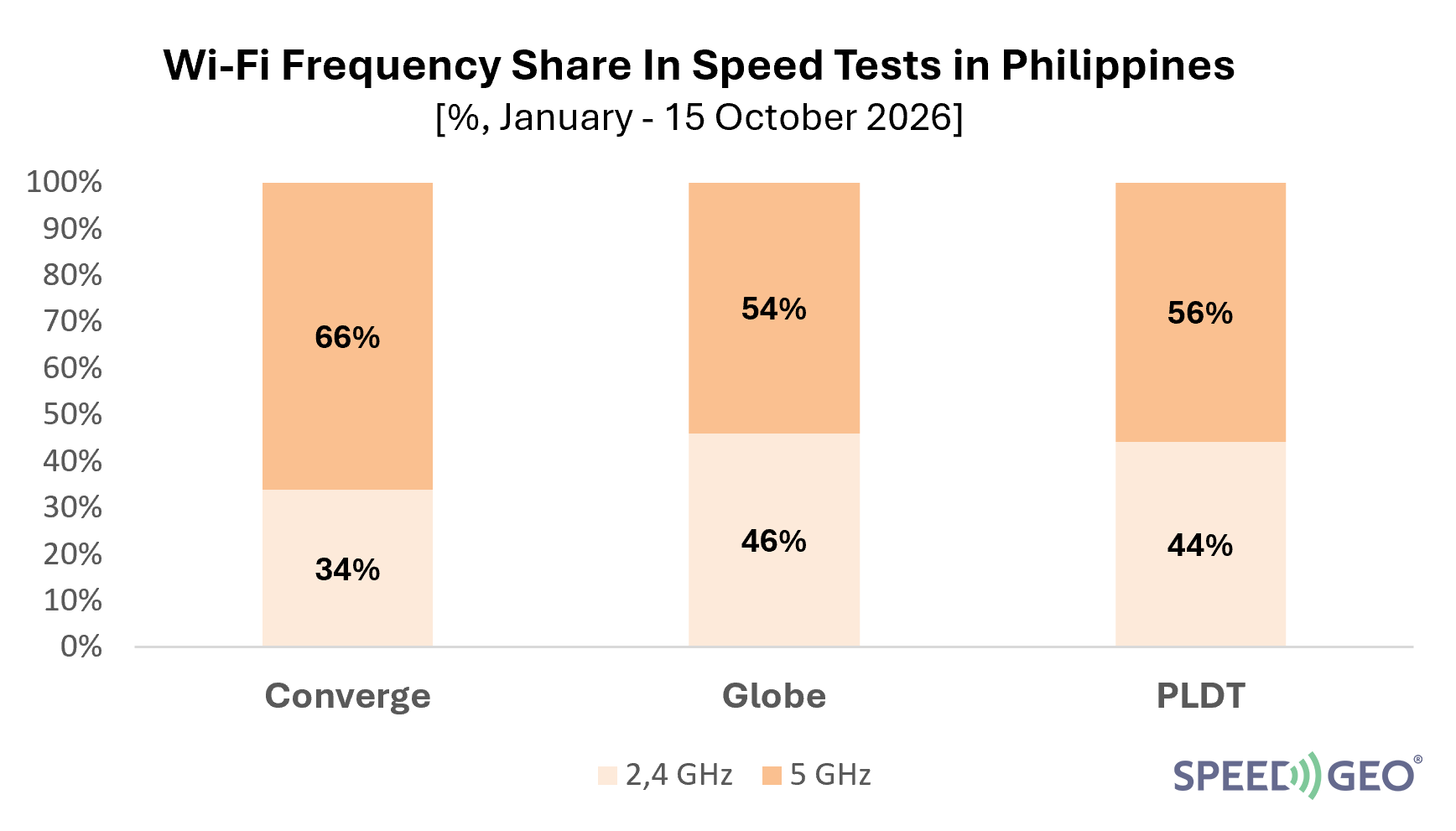
Wi-Fi is the primary way people connect to the Internet at home, and the router provided by the operator largely determines the performance. Naturally, the supported frequency bands (2.4/5 GHz) and standards (Wi-Fi 4, 5, 6, 7) play a key role. In terms of frequencies, in 2026, Converge had the highest share of tests on the faster 5 GHz band (66%), ahead of its competitors (44–46%).
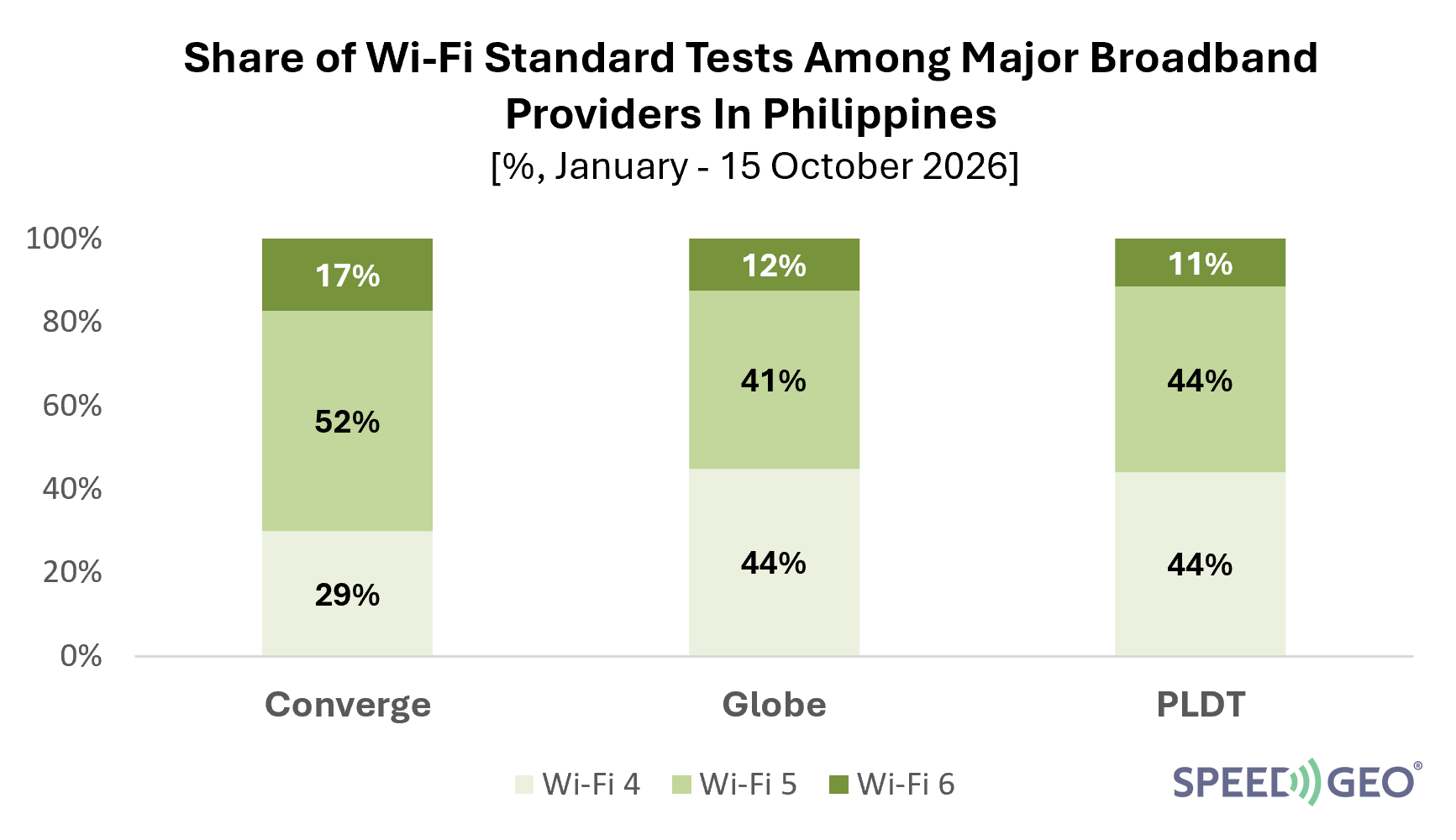
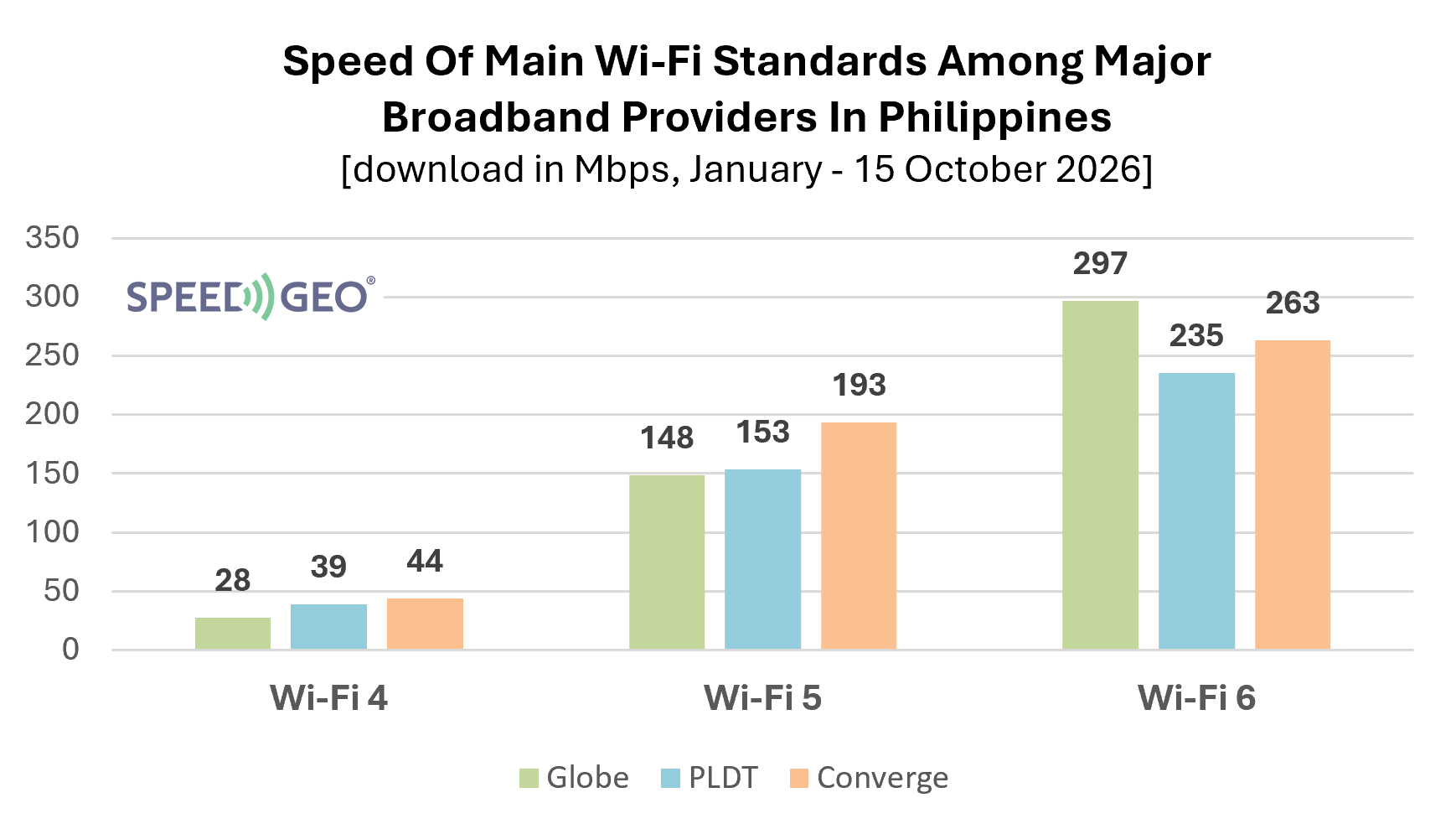
Regarding standards, Wi-Fi 4 devices reach an average of only 28–44 Mbps depending on the operator, meaning they cannot fully utilize even the entry-level 50 Mbps tier. The highest proportion of tests using this slowest technology was recorded on PLDT and Globe (44% each), while Converge had the lowest (29%).
Converge also holds an edge in Wi-Fi 5, both in test volume share (52%) and speed, which is significantly higher (193 vs. 148–153 Mbps) than the competition. Additionally, Converge boasts the highest share of Wi-Fi 6 tests (17%), though Globe delivers the top speed in this standard (297 Mbps).
Wi-Fi 6E and 7 were excluded from this analysis due to an insufficient sample size.
Tariffs as a Speed Cap
The distribution of test results shows significant stratification. As many as 29% of Globe tests, 18% of PLDT tests, and 15% of Converge tests fall into the sub-10 Mbps range. This is the result of running tests far from routers, poor Wi-Fi performance, legacy devices, and relatively slow Fixed Wireless Access (FWA) services.
The distribution of test results shows distinct peaks just below or at the speed threshold of a given tier, such as 50, 100, 200, 300, or 500 Mbps. Each peak represents a group of users with well-functioning home equipment who are maxing out their plan limit (speed cup).
The chart below illustrates the distribution of download speed tests in 2026 (up to October 15) in 5 Mbps intervals, shown as a percentage of each operator's total tests. The intervals around tariff plan speed tiers are highlighted in color. The first bar (0–5 Mbps) has been truncated: 12.5% for PLDT, 17% for Globe, and 9.8% for Converge; similarly, the second bar (5–10 Mbps) was truncated at 5.5% for PLDT, 12% for Globe, and 5.3% for Converge.
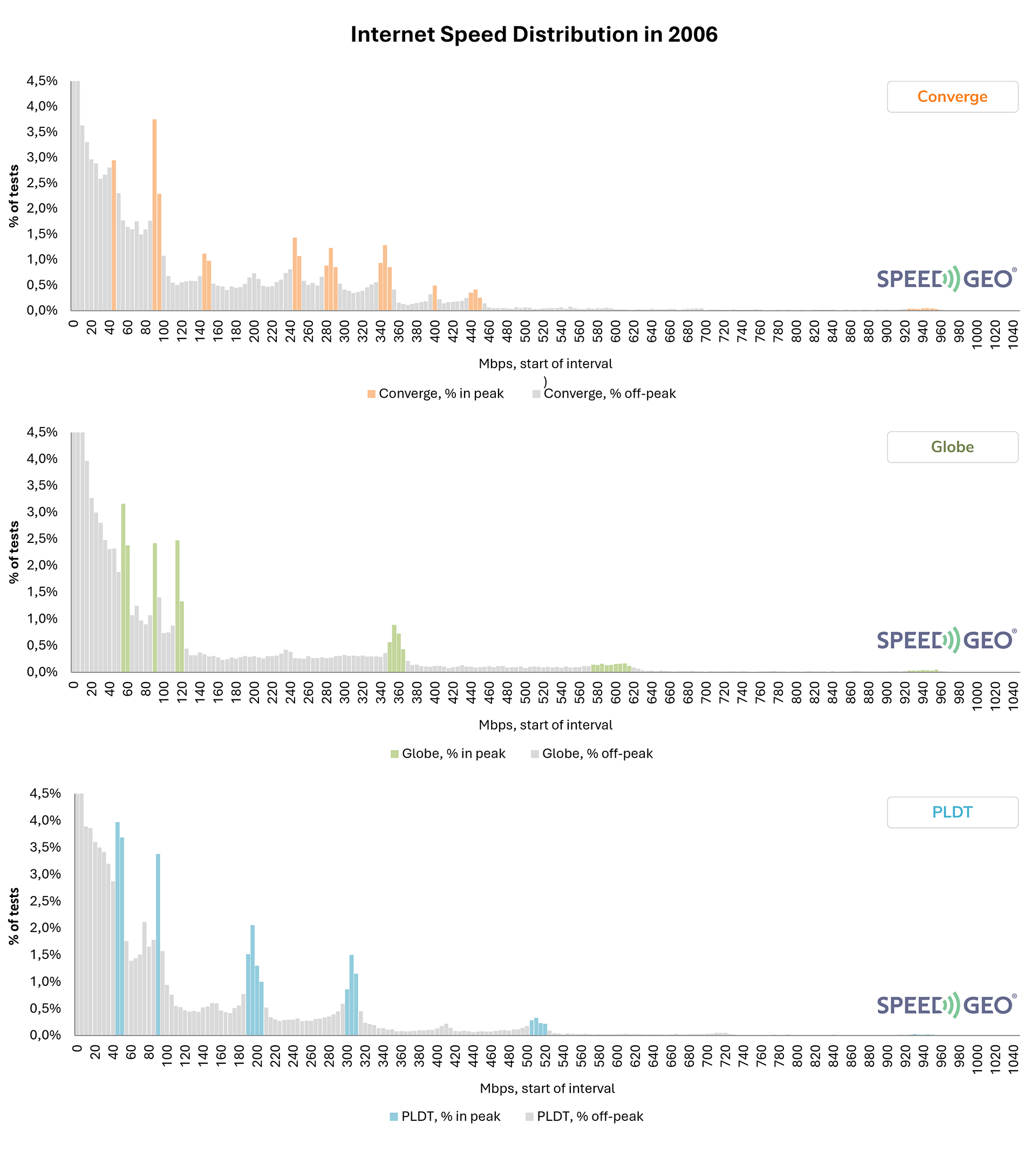
What percentage of tests hit the plan limit? We provide a range where the lower bound represents the surplus over the baseline distribution around the peak (tests that would likely have been faster without the limit, which seems to be a more realistic metric). The upper bound includes all tests within the peak window.
|
Internet Service Provider |
Likely Tariff Speed Caps (Mbps) |
Estimated Share Of Speed-capped Tests |
Speed Cap With The Highest Share Of Tests |
|
PLDT |
50 · 100 · 200 · 300 · 500 · 1000 |
10,5 - 21,7% |
50 Mbps (7,7% tests) |
|
Globe |
60 · 100 · 120 · 350 · 600 · 1000 |
8,3 - 15,8% |
60 Mbps (5,5%) |
|
Converge |
50 · 100 · 150 · 250 · 300 · 350 · 400 · 450 · 1000 |
9,1 - 21,4% |
100 Mbps (6,0%) |