
How Internet Speed Changed in South Asia from 2020 to 2026
Publication date: 11/08/2026
South Asia is currently undergoing a true telecommunications revolution. According to an analysis of over 12 million download speed tests conducted via V-Speed apps (operated by SpeedGeo.net) between 2020 and 2026, network quality in the region varies significantly. Mobile and fixed broadband performance across the seven studied countries - India, Pakistan, Bangladesh, Sri Lanka, Nepal, Afghanistan, and the Maldives - depends not only on technological advancement, but also on political, economic, and regulatory factors.
Bangladesh with the Fastest Fixed Broadband Internet in South Asia
In 2026, Bangladesh took the lead in the region in terms of broadband internet speeds. With a result of 73 Mbps, it overtaken the previous leader - India - as well as Nepal (both at 69 Mbps).
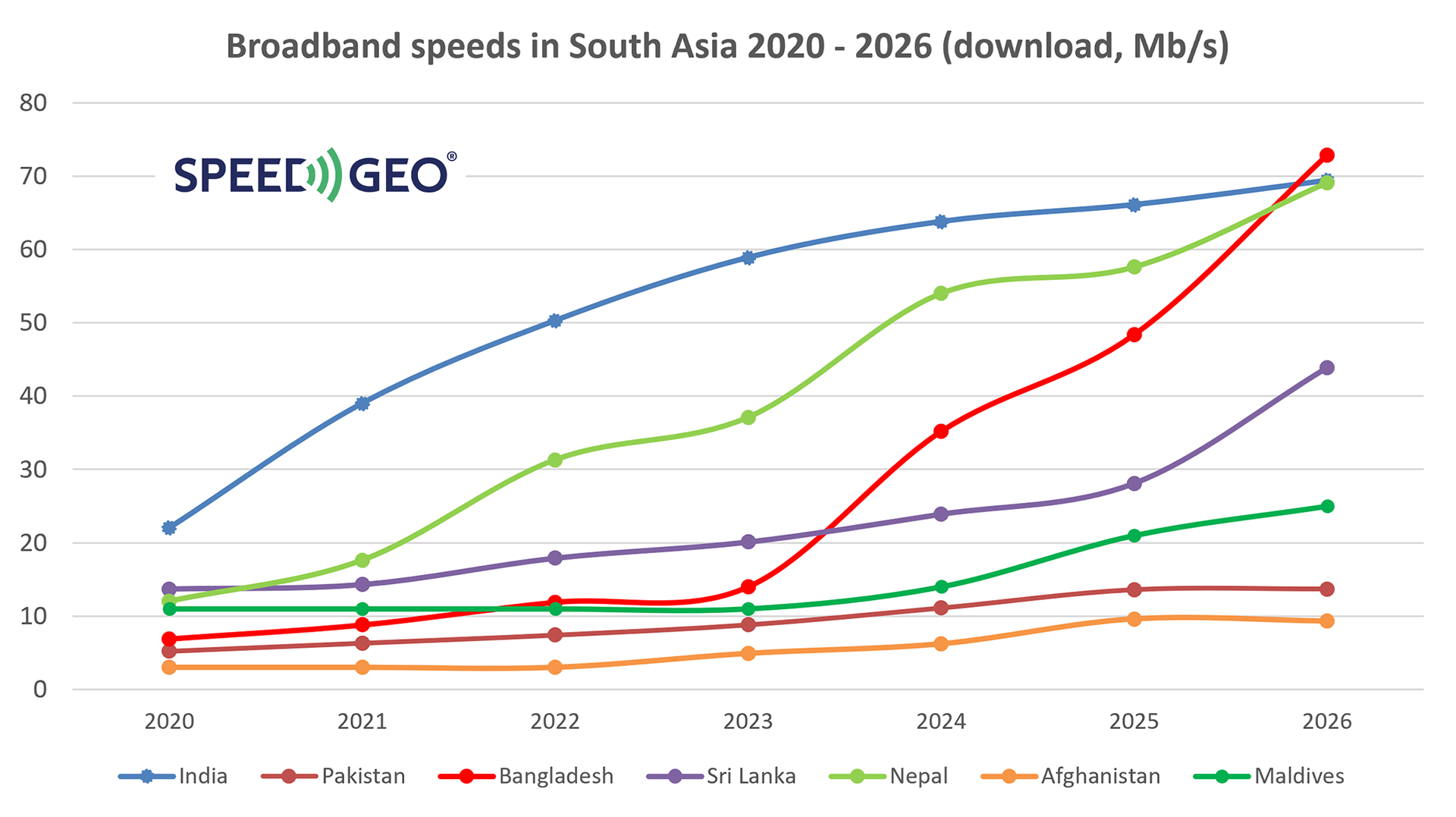
In recent years, Bangladesh began heavily expanding its fiber-optic backbone, enabling local operators to provide high-speed internet beyond Dhaka as well. Equally important was increasing international bandwidth capacity (via submarine cables). Additionally, a regulation introduced by the regulator BTRC in 2021 (and later amended) lowered the maximum rates for fixed-line connections across the country, encouraging operators to compete on quality and throughput (Mbps) rather than price. A highly fragmented market based on thousands of competing local providers and reliant on fiber-optic technologies like GPON did the rest.
Parallelly, significant progress was made in Nepal, where download speeds rose from 12 to 69 Mbps over the analyzed period. There, too, the national fiber-optic backbone was expanded, bringing high-speed internet to hard-to-reach mountain districts. Similar to Bangladesh, the country bet on FTTH and GPON. Speed growth was also driven by strong competition between private ISPs and state-owned Nepal Telecom.
Broadband speeds in India grew steadily from 22 to 69 Mbps, driven mainly by services based on the 5G rollout deployed since 2022 and the increasing penetration of FTTH. Through the BharatNet program, the government is supporting the expansion of FTTH coverage in rural areas.
Internet speeds in Sri Lanka grew very slowly at the beginning of the 2020s due to the 2022 debt crisis. Telecom operators' investments were severely curtailed at the time, and multi-hour power outages in 2022 and 2023 further disrupted fixed infrastructure. A slow recovery starting in 2023 and a slight jump in 2026 (44 Mbps) indicate that the industry has put the worst period behind it.
Fixed internet in Pakistan is developing even slower - over 6 years, speeds increased from 5 to just 14 Mbps. The problem lies in macroeconomic and regulatory instability; recurring currency crises and IMF programs discourage operators from investing in expanding the "last mile" to the end customer. Fixed internet is primarily based on mobile networks, with the first commercial 5G installations launched only in Q2 2026.
Afghanistan offers the weakest internet in the region (3-9 Mbps throughout the period). Before 2021, the country was making real progress, but the Taliban takeover in 2021 froze most infrastructure projects. Additionally, in September 2025, the government ordered a temporary shutdown of fiber-optic and mobile internet across many provinces. Internet speeds (9 Mbps in 2026) indicate that certain services, such as more advanced video streaming, remain unavailable in the country.
The Maldives remain a distinct case in this group. The fiber-optic network reaches most households on inhabited islands, and submarine cables provide the country with a solid connection to the rest of the world. The developmental barriers for the tourism-reliant Maldives differ from the rest of the region: dispersing infrastructure across more than 1,200 islands significantly raises the unit cost of every kilometer of network.
India and the Maldives: Speed Leaders Thanks to 5G
In mobile internet, the regional picture is completely different from broadband. India (106 Mbps in 2026) and the Maldives (105 Mbps) lead the pack, and in both cases, the driver is genuine, broad 5G deployment rather than symbolic trials.
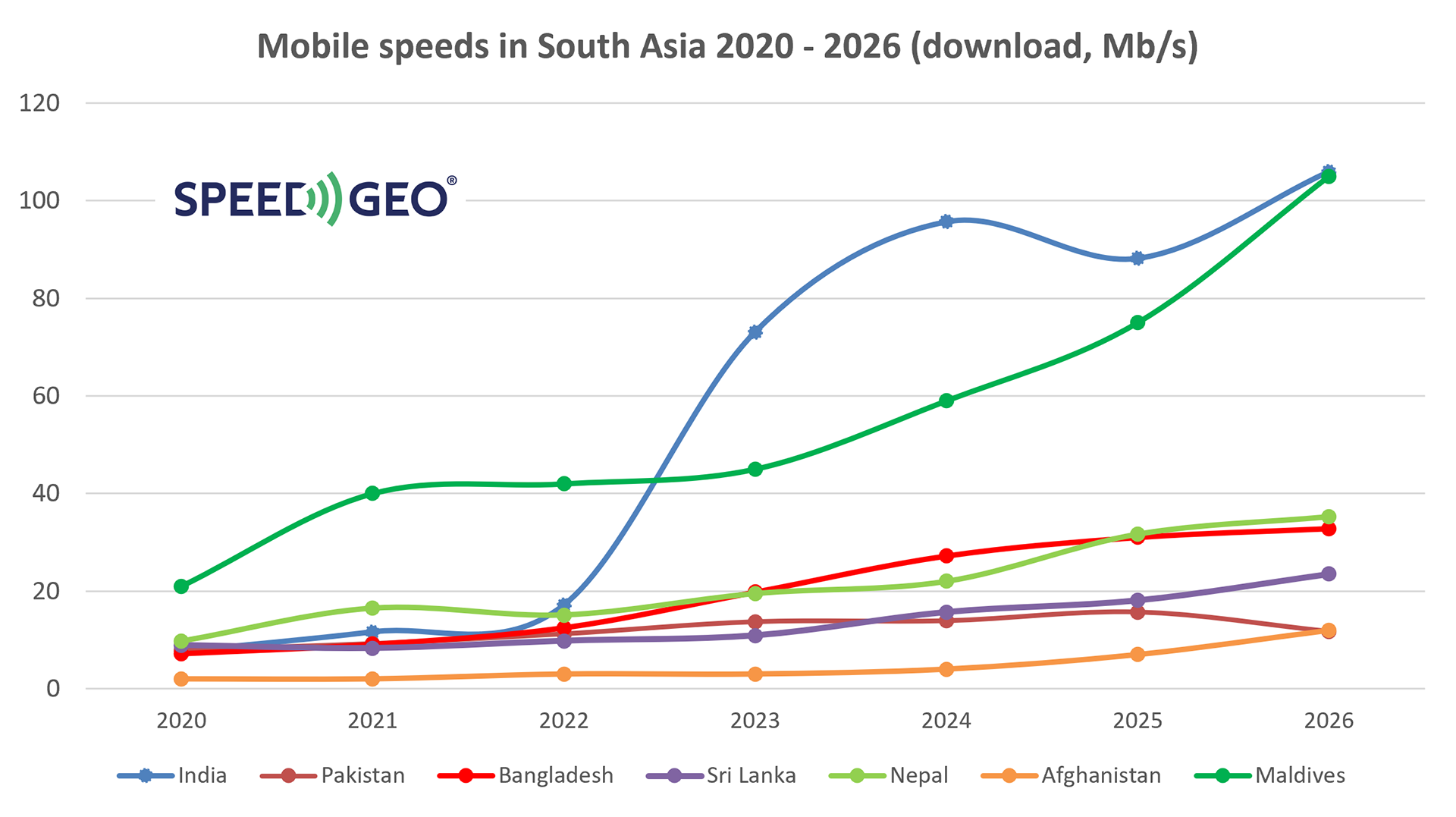
In India, mobile download speeds jumped from 17 Mbps in 2022 to 73 Mbps as early as 2023—a direct result of the commercial 5G launch on October 1, 2022, when Jio and Airtel almost immediately began building out a massive 5G network. The user base expanded exponentially, which likely contributed to a slight dip in speeds - from 96 Mbps in 2024 to 82 Mbps in 2025. This is a classic "victim of its own success" scenario: India had one of the fastest 5G rollouts in the world, but the network was adding new users faster than operators could add capacity. By 2026, India remains the regional leader with a speed of 106 Mbps.
India narrowly surpassed the Maldives, which in 2019 became the first country in South Asia to launch commercial 5G. Mobile download speeds there rose from 21 Mbps in 2020 to 105 Mbps in 2026 - a result comparable to India's, despite the Maldives having a population of just over half a million people.
In three countries (Bangladesh, Nepal, Sri Lanka), mobile internet speeds are growing, but much more slowly than in India and the Maldives - even with the formal launch of 5G in each of them. These deployments remain largely symbolic.
-
Bangladesh: The first 5G network launched in December 2021, but covered only a few government locations. The real speed increase (from 7 to 33 Mbps) is therefore driven by maturing 4G and better backhaul infrastructure (fiber and submarine cables), rather than the next-generation cellular network.
-
Nepal: Full-scale commercial 5G has still not launched. Despite successful tests, state-owned Nepal Telecom long hesitated before a full deployment due to high costs. Nevertheless, speeds in Nepal grew from 9.7 to 35.3 Mbps thanks to early 4G deployment and systematic infrastructure expansion.
-
Sri Lanka: Speed gains (from 8.9 to 23.5 Mbps) are the most subdued of the trio, compounded by the ongoing economic crisis.
Pakistan is the only country in the region where mobile internet actually deteriorated in 2026 - download speeds dropped from 16 Mbps in 2025 to 12 Mbps in 2026, despite initial 5G launches in Q2 2026. The 4G network is approaching its capacity limits; however, there is hope that a more aggressive 5G rollout will significantly boost mobile network quality later this year.
Afghanistan remains the weakest mobile market in the region (growing from 2 to 12 Mbps). While mobile networks function, authorities have regularly shut down mobile internet across entire provinces since 2025, citing moral and religious grounds. The speed increase in 2026 suggests moderate progress in network expansion.