
Orange has led Romania in fixed internet speeds since 2024
Publication date: 14/09/2026
The report is based on the analysis of speed tests conducted primarily in V-Speed mobile applications (including SpeedGeo) between 2021 and Q2 2026.
Data regarding average download speeds among the three main fixed internet providers in Romania (Digi, Vodafone, and Orange) reveals a clear pattern. All three started at a similar level in 2021- Orange reached 53 Mbps, DIGI 64 Mbps, and Vodafone 67 Mbps. Vodafone maintained a slight edge over Digi for the following two years, alongside a clear dominance over Orange (reaching roughly 50%).
![Average broadband internet speed of top operators in Romania [2021–2026, Mb/s]](/storage/article/shared/ro_broadband_speed_6aa7c232cbd3a.png)
The situation shifted dramatically in 2024 when Orange caught up with and subsequently outpaced its market rivals. By Q2 2026, Orange reached an average download speed of 240 Mbps, significantly pulling ahead of both Digi (177 Mbps) and Vodafone (149 Mbps). How did the weakest player from the start of the decade become the undisputed speed leader in 2026?
For years, the Romanian broadband market was considered DIGI's domain. As a pioneer of the Romanian fiber market, DIGI combined the construction of an extensive fiber network with affordable services for many years, making it the benchmark for the domestic market. Vodafone entered the fixed market by acquiring the cable operator UPC Romania in 2019, which owned a coaxial network based on the DOCSIS standard. While cable networks can deliver strong results, they face greater technological limitations than modern FTTH fiber.
In the fixed segment, Orange relied on wholesale agreements for years. The turning point came in 2021 with the acquisition of a majority stake in the fixed portion of Telekom Romania Communications, granting Orange access to a large, albeit technologically uneven network (a mix of FTTB, FTTH, and older infrastructure). The full legal and operational merger of both companies took place in June 2024. From that moment, Orange could execute a unified investment policy, harmonize its backbone network, and upgrade the acquired infrastructure to fiber standards. This marked the exact moment Orange began outpacing its competitors in internet speeds.
Following the merger, Orange accelerated its spending: the company declared cumulative investments exceeding one billion euros in FTTH expansion after taking over Telekom Romania, while announcing growing budgets for fixed and mobile infrastructure in subsequent years (including 237 million euros planned for 2026 to speed up fiber deployment and 5G development). The operator focused on the mass commercialization of XGS-PON services, launching "Giga Fibră"-offering speeds up to 2.1 Gbps-as its flagship product. Alongside promoting higher-speed plans, the share of users equipped with routers supporting the latest Wi-Fi 6, and more recently Wi-Fi 7, standards steadily grew.
Modern Wi-Fi at Orange
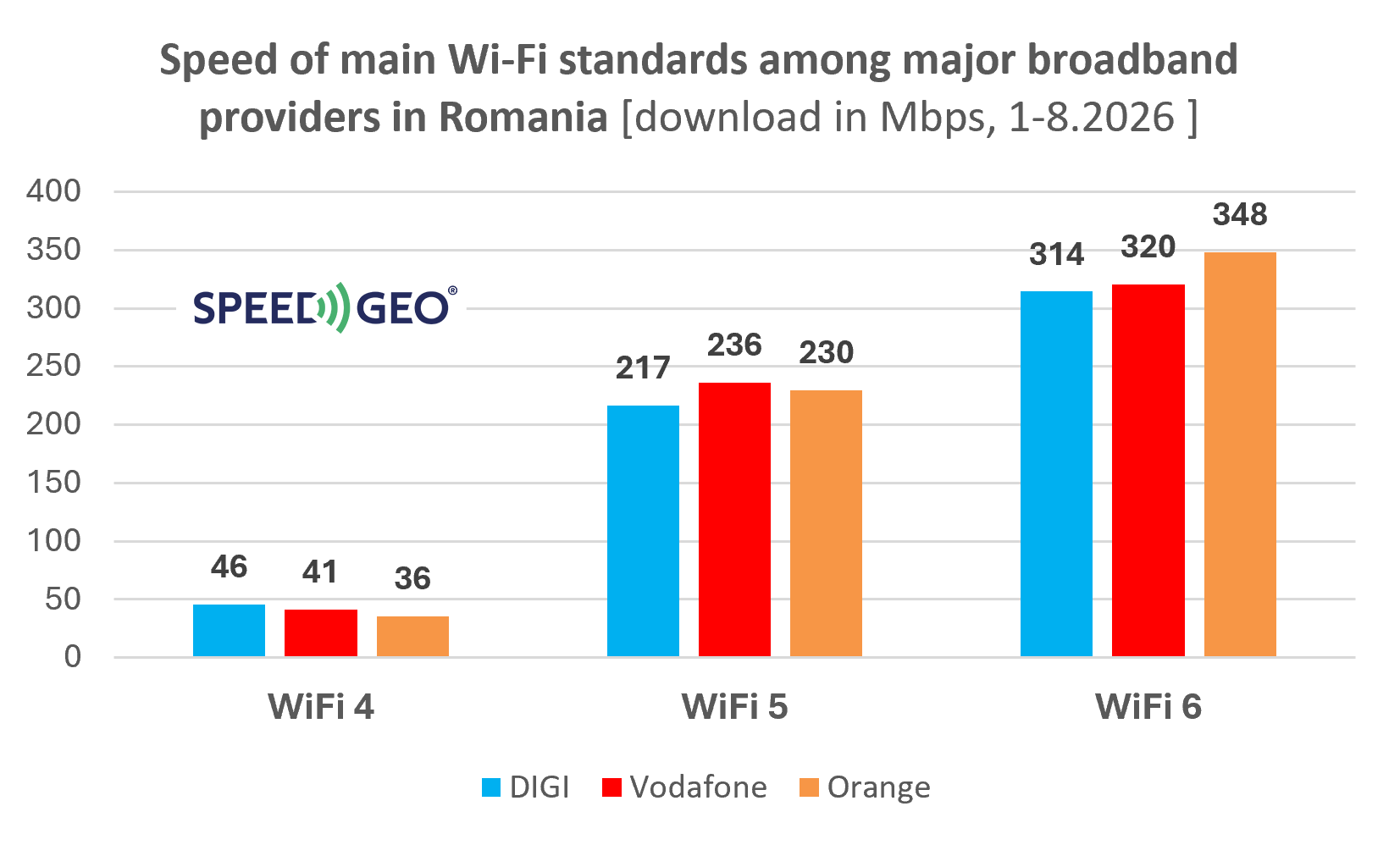
One of the sources of Orange’s advantage in recent years may have been the consistent rollout of routers supporting the latest Wi-Fi standards. The operator offered them not only to new subscribers but also systematically replaced equipment for existing customers. This hypothesis is supported by SpeedGeo user speed test results, which identified specific Wi-Fi generations-the technology serving as today's primary way of using home internet. The data shows that Orange accounts for the highest share of measurements conducted over the most modern Wi-Fi standards (Wi-Fi 5, 6, and 7)-62% compared to 56% at Vodafone and 52% at DIGI. The share of tests performed on the key standard, Wi-Fi 6, was also highest at Orange, reaching 32% vs. 25% at DIGI and a mere 7% at Vodafone. Correspondingly, Orange features the lowest share of measurements on the older, several-times-slower Wi-Fi 4 standard-37% vs. 43% at Vodafone and 46% at DIGI.
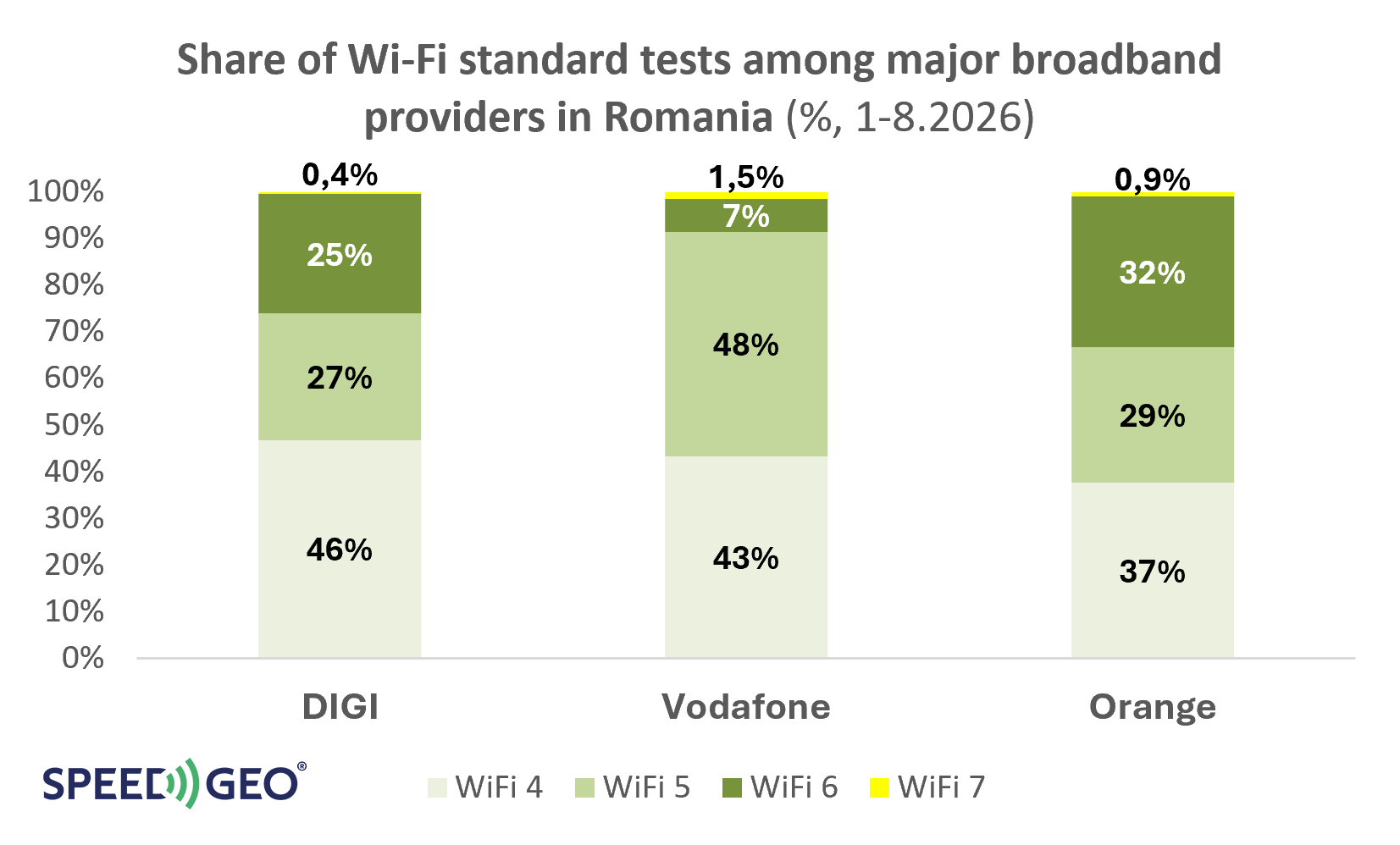
Additionally, measurements on Wi-Fi 6 within Orange’s infrastructure yield slightly higher results than those of other operators-348 Mb/s vs. 320 Mb/s at Vodafone and 314 Mb/s at DIGI. Also noteworthy is Vodafone's distinct technology adoption profile-tests on its network show a noticeably lower share of Wi-Fi 6 measurements alongside the highest share of Wi-Fi 5 among all three operators, which may point to a slower pace of router replacement. As for Wi-Fi 7, the market remains in the early stages of deployment-the standard's share across the entire sample hovers around 1%, which does not yet allow for meaningful conclusions to be drawn.
The end result is Orange establishing a visible lead starting in 2025. This advantage is not the product of a sudden technological breakthrough, but rather the cumulative effect of a lengthy market consolidation process: acquiring a technologically heterogeneous company, consolidating both entities, transitioning from FTTB/copper to FTTH, and implementing a cohesive commercial strategy.