
Poland's internet is 45% faster than Germany's
Publication date: 29/05/2026
For decades, the Polish economy remained in the shadow of Germany's economic might, yet in recent years that dynamic has begun to reverse in certain areas of infrastructure. Telecommunications is a prime example: here, the rollout of fiber-optic technology and the modernization of mobile networks have allowed Poland to build a noticeable lead over its western neighbor. An analysis of data from 2020 to 2026 indicates that the key factors behind the differing pace of development in the two countries were the operators' approach to upgrading and expanding their networks, alongside regulatory decisions.
This comparison of download speeds across German and Polish fixed and mobile networks draws on data collected between 2020 and 2026 through the V-SPEED apps (including SpeedGeo and Speed Test Light). In total, 91 million tests were analyzed (69 million from Poland and 22 million from Germany). For fixed-line internet, and in order to keep the data sources consistent, the analysis focused on tests run over Wi-Fi as the most common means of access.
Broadband internet — 45% faster in Poland
In 2020 and 2021, broadband speeds in the two countries were broadly similar, with Germany holding a slight edge. Poland's internet began to accelerate more sharply from 2022 onward — a sign of accumulated investment in fiber, a strong migration from DSL to FTTH, the modernization of cable networks, and the marketing push that came with it, promoting plans with higher speeds. As a result, by March 2026 Poland's internet was as much as 45% faster than Germany's.
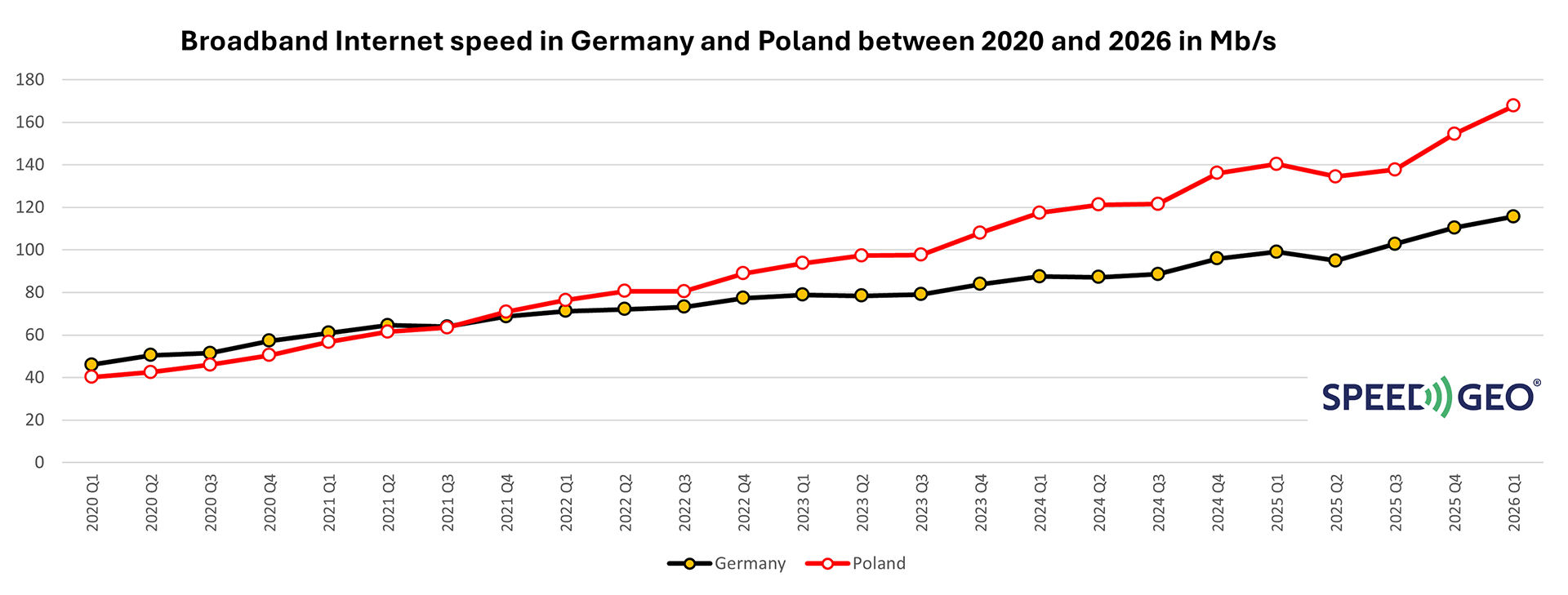
The key to Poland's rapid growth lies in a strategy of skipping intermediate technological stages and streamlining the investment process. Unlike their German counterparts, Polish operators wasted neither time nor money modernizing old copper lines. They bet heavily on fiber, while developing cable networks in parallel. Beyond the telecom companies' own spending, a major boost to the market came from deliberate public support. Programs such as Digital Poland (POPC) and the National Recovery Plan (KPO) helped finance the construction of modern infrastructure in previously underserved areas, eliminating the so-called white spots on the country's map. Over the same period, Germany recorded steady but considerably slower growth. This stemmed from its historical reliance on copper technology (VDSL), which ultimately proved difficult to scale. Although the "Gigabit-Strategie" unveiled by Berlin in 2022 calls for a complete switch to fiber by 2030, upgrading such a vast and outdated copper base will likely take our neighbors at least a decade.
Beyond the outdated technology mix, one of the main reasons for Germany's slower network expansion was bureaucracy. Poland adapted its laws more quickly, amending the so-called Mega Act in 2016 and 2019 to simplify the investment process, shorten permit-issuing times, and impose an obligation to cooperate on infrastructure owners. Energy, water, and district-heating companies were required to open up their infrastructure — ducts, poles, and towers — to fiber operators. Among other measures, the head of the UKE (the national telecoms regulator) capped the rates for hanging a cable to a pole, preventing infrastructure owners from blocking competitors with high prices. As a result, Poland is one of Europe's leaders in the use of overhead infrastructure, which enabled the rapid digitization of rural areas: stringing a cable along poles rather than burying it in the ground significantly lowered costs and sped up the work. Another breakthrough was the reduction of road-easement fees. Simplifying the procedures for building telecom connections provided a further major boost to investment. Consequently, the infrastructure in many Polish villages is now no less modern than in large cities.
In Germany, cables were laid deep underground, and individual states and municipalities applied their own procedures. The absence of nationwide rules to streamline investment made network construction among the slowest and most expensive in Europe. Recent legal changes have simplified and sped up the process of applying for construction and road-easement permits, and allowed for the faster, cheaper method of microtrenching. The need to support investment is underscored by the fact that Germany has classified the construction of fiber networks as a matter of "overriding public interest." The modernization and migration to FTTH/FTTB has accelerated considerably in recent years, though significant barriers remain — among them, building managers' reluctance to replace existing infrastructure.
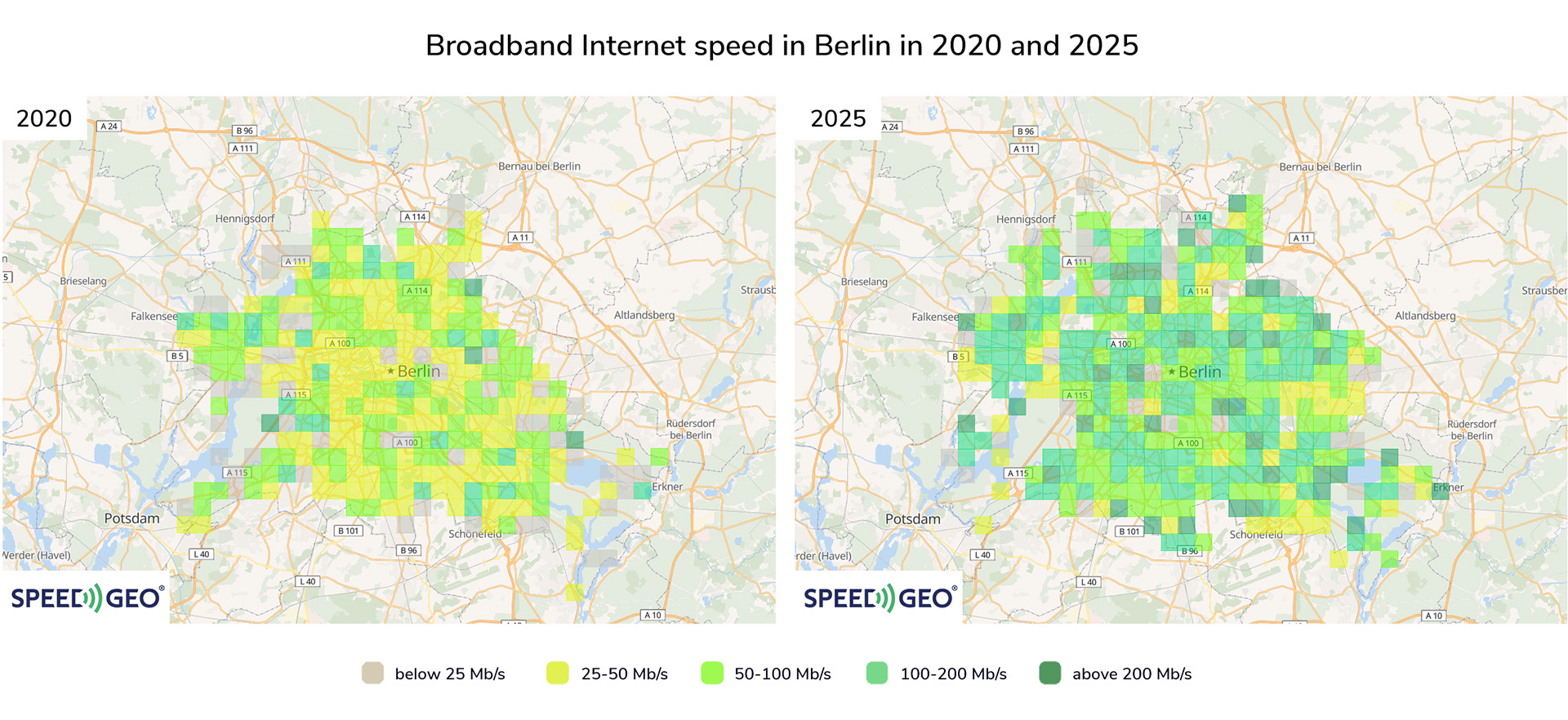
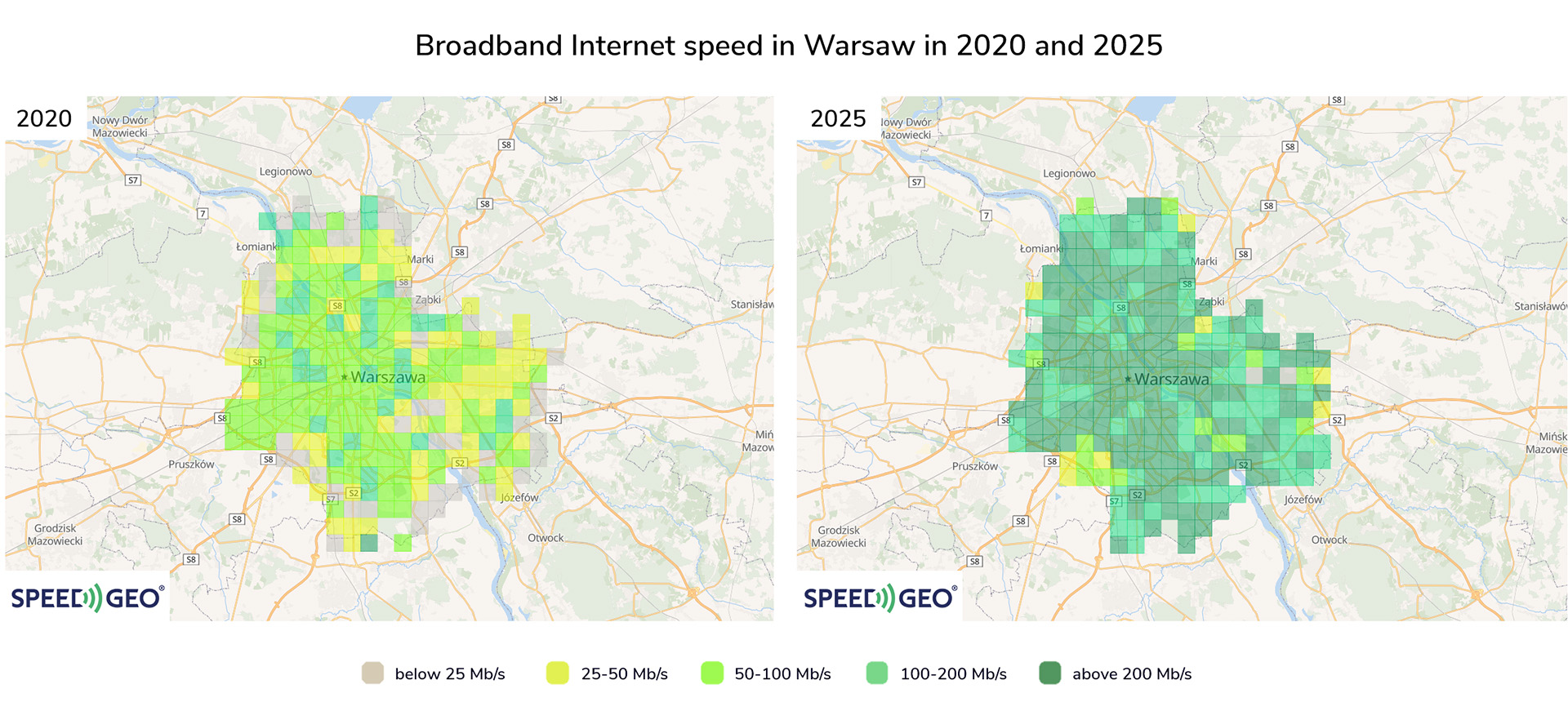
The differences are even greater in the two countries' largest cities. The accumulation of technological legacies and administrative barriers is clearly visible on the fixed-internet speed maps of the two capitals — in theory, the very places where infrastructure should be at its best. In Berlin, the average download speed rose from 47 Mbps in Q1 2020 to 126 Mbps in Q1 2026; in Warsaw, the figures were 63 and 261 Mbps respectively. Warsaw's internet is therefore now more than twice as fast as Berlin's. In other German cities, the Q1 2026 figures did not differ significantly from Berlin's: Munich — 151 Mbps, Düsseldorf — 118 Mbps, Hamburg — 116 Mbps, and Frankfurt am Main — 128 Mbps. In Poland, meanwhile, average speeds reach 202 Mbps in Kraków, 213 Mbps in Łódź, 222 Mbps in Wrocław, 231 Mbps in Katowice, and 227 Mbps in Poznań.
The maps below show the distribution of broadband download speeds in Berlin and Warsaw in 2020 and 2025:
In 2026, Germany embarked on further legal changes that will liberalize the investment process even more, so we should expect a major surge in investment in the near future.
Mobile internet — 44% faster in Poland
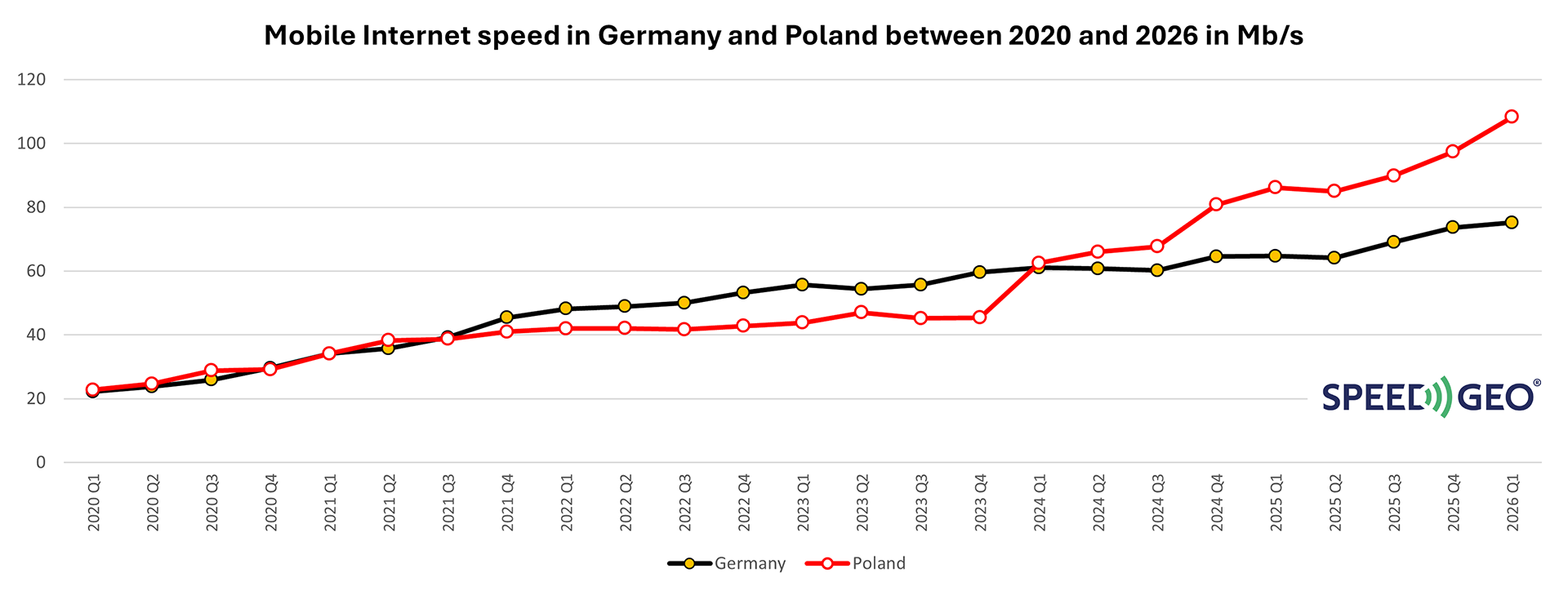
In the case of mobile internet, much suggested that Germany — having settled its auction for new 5G frequencies in 2019, including the efficient 3.6 GHz band (known as the C-band) — would pull away from Poland, which was beginning its 5G rollout on DSS, a technology that offered users virtually no benefits. That did not happen, however, and average download speeds in the two countries remained at the same level almost until the end of 2021. Germany's C-band rollout appears to have been evolutionary: the priority was building coverage on lower-speed but longer-range bands (such as 700 MHz), and on top of that, some operators were still relying on DSS. Initially, 3.6 GHz coverage was built as a supplement to the network in the busiest, highest-traffic locations. In recent years, though, the 3.6 GHz rollout has accelerated considerably, which will likely be reflected in the figures.
Poland's story was different. Despite the absence of "true 5G" at T-Mobile, Orange, and Play, the operators handled the "Covid-era" flood of traffic remarkably well by investing in expanded LTE capacity. It was only in 2022 and 2023 that Germany's 5G rollout allowed it to maintain a stable lead of around 15–25% over Poland's internet through the end of 2023. It was clear that without new frequencies, Poland's mobile networks would soon run out of steam — in the second half of 2023, speeds began to slowly decline for the first time in the history of this category. The delayed auction for the 3.6 GHz band was settled just as the first problems with handling growing traffic began to appear. The operators were already technically ready to support the new band, and from the start of 2024, mobile internet speeds quite literally took off. As early as Q1 2024, Poland's average speed leaped past Germany's, erasing a 24% gap! The auction requirements played a major role here, mandating the rapid construction of a 5G network based on 3.6 GHz. What's more, the delays in allocating frequencies had prompted Polish operators to upgrade their 4G LTE capacity to the highest standards earlier than planned, which — combined with the 5G rollout — produced a cumulative effect. Ultimately, Poles can today enjoy mobile internet that is roughly 44% faster than their neighbors'.
Author: Piotr Choluj
Contact author: [email protected]